Wolfram Language Paclet Repository

Community-contributed installable additions to the Wolfram Language

Primary Navigation

    • Cloud & Deployment
    • Core Language & Structure
    • Data Manipulation & Analysis
    • Engineering Data & Computation
    • External Interfaces & Connections
    • Financial Data & Computation
    • Geographic Data & Computation
    • Geometry
    • Graphs & Networks
    • Higher Mathematical Computation
    • Images
    • Knowledge Representation & Natural Language
    • Machine Learning
    • Notebook Documents & Presentation
    • Scientific and Medical Data & Computation
    • Social, Cultural & Linguistic Data
    • Strings & Text
    • Symbolic & Numeric Computation
    • System Operation & Setup
    • Time-Related Computation
    • User Interface Construction
    • Visualization & Graphics
    • Random Paclet
    • Alphabetical List
  • Using Paclets
    • Get Started
    • Download Definition Notebook
  • Learn More about Wolfram Language

QuantumFramework

Tutorials

  • Getting Started
  • Quantum Object Composition

Guides

  • Wolfram Quantum Computation Framework

Tech Notes

  • Bell's Theorem: CHSH inequality
  • Circuit Diagram
  • Exploring Fundamentals of Quantum Theory
  • An IBM Quantum Error Map
  • QPU Service Connection
  • Quantum object abstraction
  • Quantum Optimization
  • Second Quantization Functions
  • Sending Queries to IBM QPUs
  • Tensor Network
  • Quantum Computation

Symbols

  • CliffordChannel
  • EinsteinSummation
  • GraphState
  • IBMJob
  • IBMJobSubmit
  • LocalComplement
  • PauliStabilizer
  • QiskitCircuit
  • QiskitTarget
  • QuantumBasis
  • QuantumChannel
  • QuantumCircuitMultiwayGraph [EXPERIMENTAL]
  • QuantumCircuitOperator
  • QuantumDistance
  • QuantumEntangledQ
  • QuantumEntanglementMonotone
  • QuantumEvolve
  • QuantumMeasurement
  • QuantumMeasurementOperator
  • QuantumMeasurementSimulation
  • QuantumMPS [EXPERIMENTAL]
  • QuantumOperator
  • QuantumPartialTrace
  • QuantumPhaseSpaceTransform
  • QuantumQASM
  • QuantumShortcut [EXPERIMENTAL]
  • QuantumSimilarity
  • QuantumStateEstimate [EXPERIMENTAL]
  • QuantumState
  • QuantumTensorProduct
  • QuantumWignerMICTransform [EXPERIMENTAL]
  • QuantumWignerTransform [EXPERIMENTAL]
  • QuditBasis
  • QuditName
  • StabilizerFrame
  • StabilizerStateQ
Wolfram`QuantumFramework`
QiskitCircuit
​
QiskitCircuit
[qco]
builds a qiskit circuit from the
QuantumCircuitOperator
qco.
​
​
QiskitCircuit
["qasm"]
builds a qiskit circuit from OpenQASM source qasm.
​
Details and Options
▪
A
QiskitCircuit
is the bridge between
QuantumFramework
and qiskit: it wraps a pickled qiskit
QuantumCircuit
as a
ByteArray
and exposes it through a property interface.
▪
A
QiskitCircuit
is produced by
QuantumCircuitOperator
's
"Qiskit"
property, by
QuantumQASM
import, and by the transform properties below;
QuantumCircuitOperator
[qkc]
converts one back to a
QuantumCircuitOperator
.
▪
QiskitCircuit
["qasm"]
accepts OpenQASM 2.0 or 3.0 source: the source is read with
QuantumCircuitOperator
and re-emitted to qiskit, so it is equivalent to
QuantumCircuitOperator["qasm"]["Qiskit"]
. A string that is not OpenQASM gives a
Failure
(see Possible Issues).
▪
Applying a
QiskitCircuit
qkc runs the circuit:
qkc[]
simulates it and gives a
QuantumState
, and
qkc[state]
runs it on an initial
QuantumState
state. Options include
"Shots"
,
"Provider"
and
"Backend"
.
▪
A
QiskitCircuit
qkc gives a property with
qkc["prop"]
, with the properties in the table below.
▪
Property evaluation runs in the framework's qiskit Python session, which is set up automatically. The hardware-facing properties
"Transpile"
,
"Layout"
,
"Validate"
,
"QPY"
, and running qkc on a provider additionally need that provider configured (an IBM or AWS account); the default for
qkc[]
is a local Aer simulator.
▪
A
QiskitCircuit
displays as a summary panel showing its qubit count, depth, and gate counts.
Property
Result
"Qubits"
the number of qubits
"Depth"
the circuit depth
"Ops"
the gate counts, an Association of gate name to count
"Clbits"
the classical-bit indices
"QuantumCircuitOperator"
convert to a
QuantumCircuitOperator
(also
"QuantumCircuit"
)
"QuantumOperator"
the circuit unitary as a
QuantumOperator
"Matrix"
the unitary matrix
"Diagram"
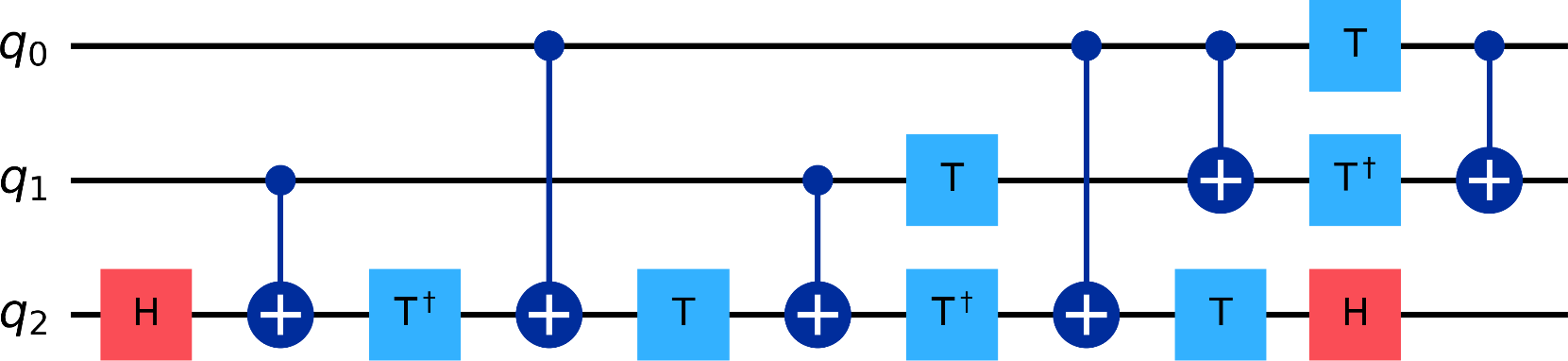
qiskit's Matplotlib drawing of the circuit
"Graphics"
the circuit drawn through LaTeX
"QASM"
,
"QASM2"
OpenQASM 2.0 source
"QASM3"
OpenQASM 3.0 source
"QPY"
compressed qiskit QPY bytes
"Decompose"
, n
decompose each gate n times, giving a
QiskitCircuit
"Transpile"
, basis
transpile to a native basis or backend, giving a
QiskitCircuit
"Layout"
a plot of the transpiled qubit layout on a backend
"Validate"
validate the circuit on an IBM backend
"Bytes"
the underlying pickled qiskit circuit, a
ByteArray
​
Examples  
(11)
Basic Examples  
(1)
A circuit in
QuantumFramework
, drawn with its
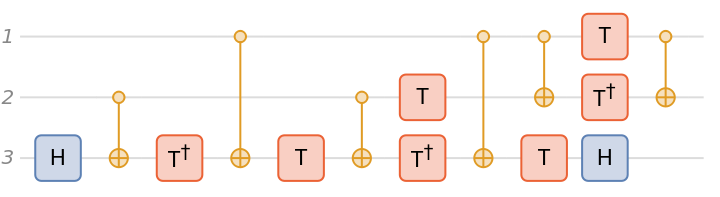
QuantumCircuitOperator
"Diagram"
:
In[1]:=
QuantumCircuitOperator
["Toffoli"]["Diagram"]
Out[1]=
QiskitCircuit
builds the same circuit as a qiskit object, shown as a summary panel of its qubit count, depth, and gate counts:
In[2]:=
QiskitCircuit
QuantumCircuitOperator
["Toffoli"]
Out[2]=
QiskitCircuit
Qubits: 3
Depth: 11

The
"Diagram"
property draws it the way qiskit does, so the two diagrams above and below are the same circuit in each framework's notation:
In[3]:=
QiskitCircuit
QuantumCircuitOperator
["Toffoli"]["Diagram"]
Out[3]=
Scope  
(9)

Possible Issues  
(1)

SeeAlso
QuantumCircuitOperator
 
▪
QuantumQASM
 
▪
QiskitTarget
 
▪
IBMJobSubmit
RelatedGuides
▪
WolframQuantumComputationFramework
""

© 2026 Wolfram. All rights reserved.

  • Legal & Privacy Policy
  • Contact Us
  • WolframAlpha.com
  • WolframCloud.com