Wolfram Language
Paclet Repository
Community-contributed installable additions to the Wolfram Language
Primary Navigation
Categories
Cloud & Deployment
Core Language & Structure
Data Manipulation & Analysis
Engineering Data & Computation
External Interfaces & Connections
Financial Data & Computation
Geographic Data & Computation
Geometry
Graphs & Networks
Higher Mathematical Computation
Images
Knowledge Representation & Natural Language
Machine Learning
Notebook Documents & Presentation
Scientific and Medical Data & Computation
Social, Cultural & Linguistic Data
Strings & Text
Symbolic & Numeric Computation
System Operation & Setup
Time-Related Computation
User Interface Construction
Visualization & Graphics
Random Paclet
Alphabetical List
Using Paclets
Create a Paclet
Get Started
Download Definition Notebook
Learn More about
Wolfram Language
QuantumChemistry
Symbols
ComputeVibrationalModes
ElectronicStructurePlot3D
ElectronicStructureResult
ModelChemistry
OptimizeMoleculeGeometry
PotentialEnergyScan
SinglePointEnergy
WolframChemistry`QuantumChemistry`
P
o
t
e
n
t
i
a
l
E
n
e
r
g
y
S
c
a
n
P
o
t
e
n
t
i
a
l
E
n
e
r
g
y
S
c
a
n
[
m
o
l
,
{
{
i
,
j
}
,
r
1
,
r
2
,
d
r
}
]
s
c
a
n
s
t
h
e
d
i
s
t
a
n
c
e
b
e
t
w
e
e
n
a
t
o
m
s
i
a
n
d
j
f
r
o
m
r
1
t
o
r
2
i
n
s
t
e
p
s
o
f
d
r
.
P
o
t
e
n
t
i
a
l
E
n
e
r
g
y
S
c
a
n
[
m
o
l
,
{
{
i
,
j
,
k
}
,
a
1
,
a
2
,
d
a
}
]
s
c
a
n
s
t
h
e
a
n
g
l
e
b
e
t
w
e
e
n
a
t
o
m
s
i
,
j
,
a
n
d
k
f
r
o
m
a
1
t
o
a
2
i
n
s
t
e
p
s
o
f
d
a
.
P
o
t
e
n
t
i
a
l
E
n
e
r
g
y
S
c
a
n
[
m
o
l
,
{
{
i
,
j
,
k
,
l
}
,
a
1
,
a
2
,
d
a
}
]
s
c
a
n
s
t
h
e
d
i
h
e
d
r
a
l
a
n
g
l
e
b
e
t
w
e
e
n
a
t
o
m
s
i
,
j
,
k
,
a
n
d
l
f
r
o
m
a
1
t
o
a
2
i
n
s
t
e
p
s
o
f
d
a
.
P
o
t
e
n
t
i
a
l
E
n
e
r
g
y
S
c
a
n
[
m
o
l
,
s
p
e
c
,
m
o
d
e
l
C
h
e
m
i
s
t
r
y
]
u
s
e
s
t
h
e
s
p
e
c
i
f
i
e
d
m
o
d
e
l
c
h
e
m
i
s
t
r
y
t
o
p
e
r
f
o
r
m
t
h
e
s
c
a
n
.
Examples
(
1
)
Basic Examples
(
1
)
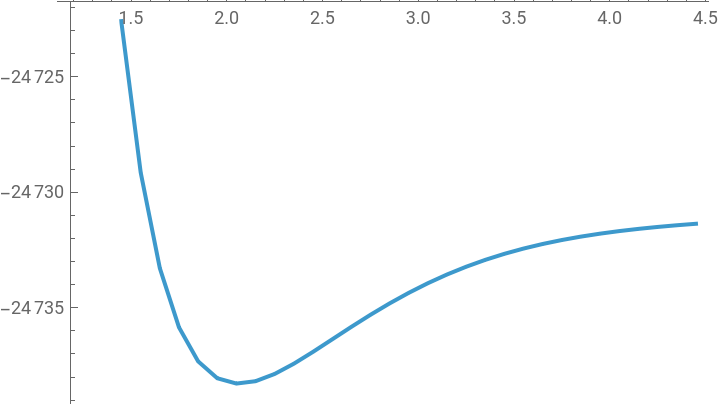
Scan the only bond in Cl2, here labeled {1,2}, from 1.25 angstroms to 4.5 angstroms:
I
n
[
1
]
:
=
P
o
t
e
n
t
i
a
l
E
n
e
r
g
y
S
c
a
n
[
M
o
l
e
c
u
l
e
[
"
[
C
l
]
[
C
l
]
"
]
,
{
{
1
,
2
}
,
1
.
2
5
,
4
.
5
,
.
1
}
]
O
u
t
[
1
]
=
Q
u
a
n
t
i
t
y
A
r
r
a
y
D
i
m
e
n
s
i
o
n
s
:
{
3
3
,
2
}
U
n
i
t
s
:
{
A
n
g
s
t
r
o
m
s
,
E
l
e
c
t
r
o
n
v
o
l
t
s
}
I
n
[
2
]
:
=
L
i
s
t
L
i
n
e
P
l
o
t
@
%
O
u
t
[
2
]
=
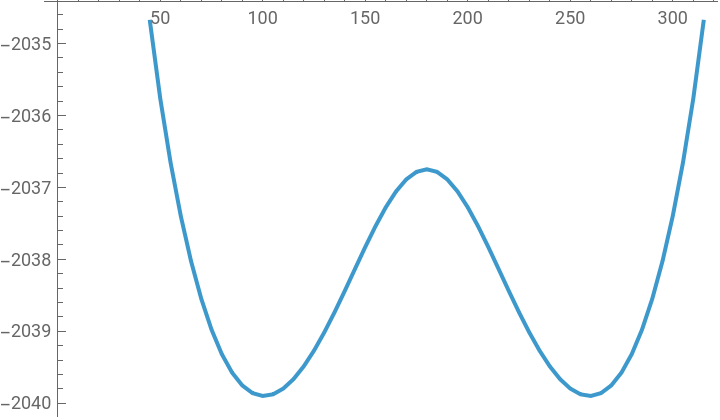
Scan the bond angle for water:
I
n
[
3
]
:
=
P
o
t
e
n
t
i
a
l
E
n
e
r
g
y
S
c
a
n
[
M
o
l
e
c
u
l
e
[
"
[
H
]
[
O
]
[
H
]
"
]
,
{
{
1
,
2
,
3
}
,
3
1
5
,
4
5
,
-
5
}
]
O
u
t
[
3
]
=
Q
u
a
n
t
i
t
y
A
r
r
a
y
D
i
m
e
n
s
i
o
n
s
:
{
5
5
,
2
}
U
n
i
t
s
:
{
A
n
g
u
l
a
r
D
e
g
r
e
e
s
,
E
l
e
c
t
r
o
n
v
o
l
t
s
}
I
n
[
4
]
:
=
L
i
s
t
L
i
n
e
P
l
o
t
@
%
O
u
t
[
4
]
=
Do a 2D potential scan:
I
n
[
5
]
:
=
P
o
t
e
n
t
i
a
l
E
n
e
r
g
y
S
c
a
n
[
M
o
l
e
c
u
l
e
[
"
[
H
]
[
O
]
[
H
]
"
]
,
{
(
*
f
i
r
s
t
s
c
a
n
t
h
e
a
n
g
l
e
f
r
o
m
6
0
t
o
1
6
0
*
)
{
{
1
,
2
,
3
}
,
6
0
,
1
6
0
,
5
}
,
(
*
n
e
x
t
s
c
a
n
b
o
n
d
1
,
2
f
r
o
m
.
5
t
o
1
.
5
a
n
g
s
t
r
o
m
s
*
)
{
{
1
,
2
}
,
.
5
,
1
.
5
,
.
1
}
}
]
O
u
t
[
5
]
=
Q
u
a
n
t
i
t
y
A
r
r
a
y
D
i
m
e
n
s
i
o
n
s
:
{
2
3
1
,
3
}
U
n
i
t
s
:
{
A
n
g
u
l
a
r
D
e
g
r
e
e
s
,
A
n
g
s
t
r
o
m
s
,
E
l
e
c
t
r
o
n
v
o
l
t
s
}
I
n
[
6
]
:
=
L
i
s
t
P
l
o
t
3
D
@
%
O
u
t
[
6
]
=
"
"