Basic Examples (2)
Get the complete network at each step for an automaton that gives the NOT of its own state:
Define a Boolean network of three automata where automaton 1 gives the NOT of automaton 3, automaton 2 gives the AND of automata 1 and 3, and automaton 3 gives the XOR of automata 1 and 2:
Evolve the network for 8 steps, starting with every automaton in state 0:
Scope (6)
Three automata with states 0, 1 and 2 are given by tables of rules:
Automaton 1 uses the state of automaton 2 twice:
Labels can be strings:
Labels do not have to match positions, so the states in the result are in the order of the automata in the list:
This automaton counts modulo 4 using its own state as an input:
Use expression-based states to create an automata network modeling a pedestrian signal that follows a traffic light:
By using patterns and conditions in the rules we create a ring of automata where each becomes 1 when at least two of itself and its two neighbors are 1:
Applications (3)
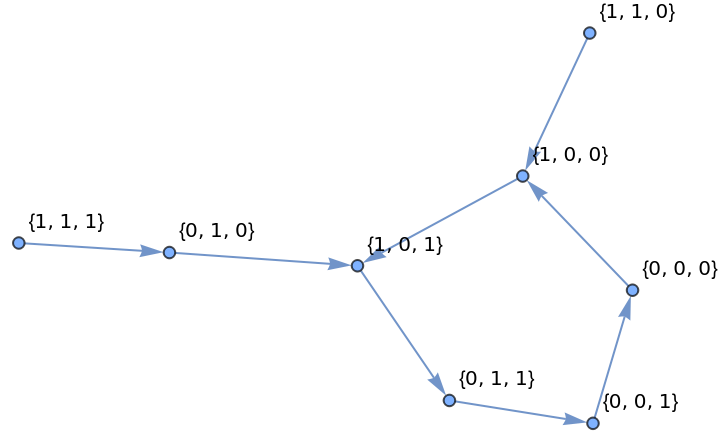
The state transition graph of the Boolean network from Basic Examples links each list of the states to the next one:
Every evolution of this network ends in the same cycle of five states, which is its only attractor:
Model a synchronous 3-bit binary counter where automaton 1 is the lowest bit, and each bit flips when all lower bits are 1:
Read the bits as binary numbers:
Simulate a random Boolean network (as used by Kauffman to model gene regulation) where each of 40 automata has 2 random inputs and a random Boolean function:
Find the lengths of the transient and of the cycle that the network settles into:
Properties and Relations (3)
A network in which each automaton on a ring uses its left neighbor, itself and its right neighbor gives the same evolution as CellularAutomaton:
Reordering the automata reorders the states in the result but does not change the evolution:
With finitely many states every evolution eventually repeats; use FindTransientRepeat to find the transient and the repeating cycle:
Possible Issues (5)
If no rule matches the states of the inputs then the new state is the list of those states:
Add a rule with a general pattern at the end to give a default state:
Each automaton must have at least one input:
For an automaton with a constant state one can use its own state as the input:
If a label in inputsi does not belong to any automaton, then the state becomes a list that contains Missing, and no message is issued:
If several automata have the same label then the first of them is used as the input:
init must have one state for each automaton. Otherwise, a message is issued and the result is not evaluated:
Neat Examples (2)
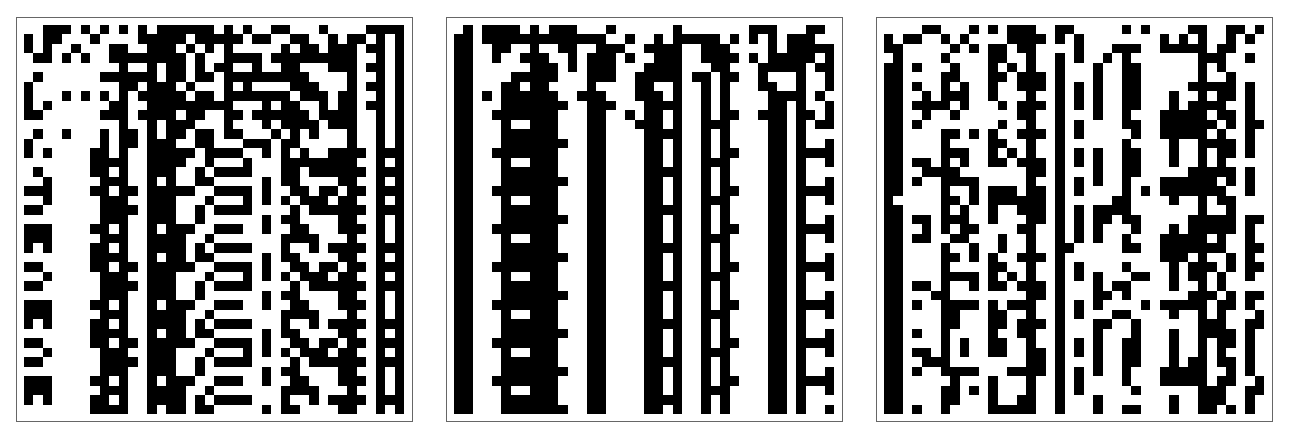
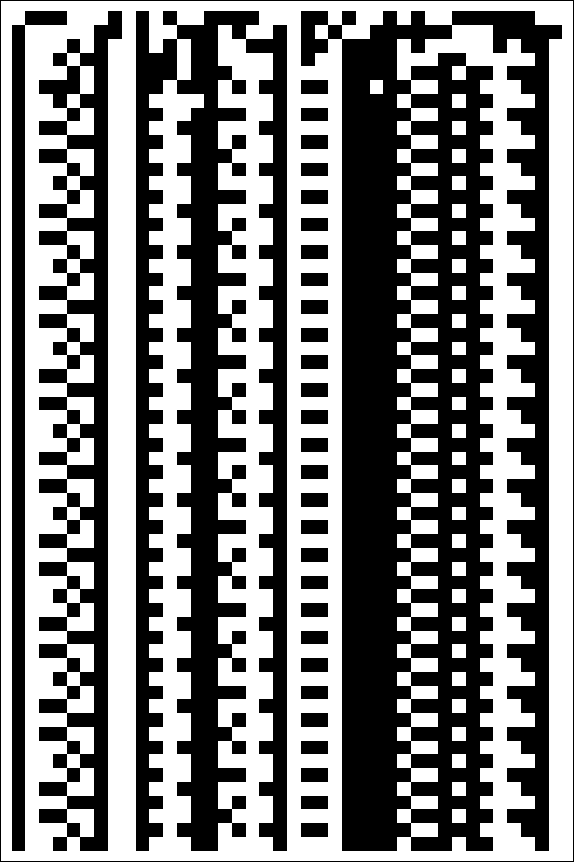
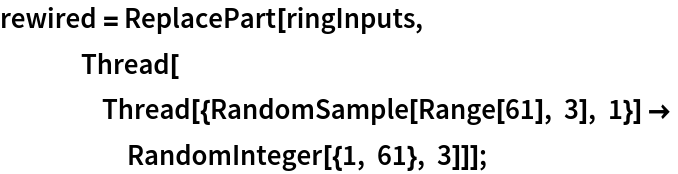
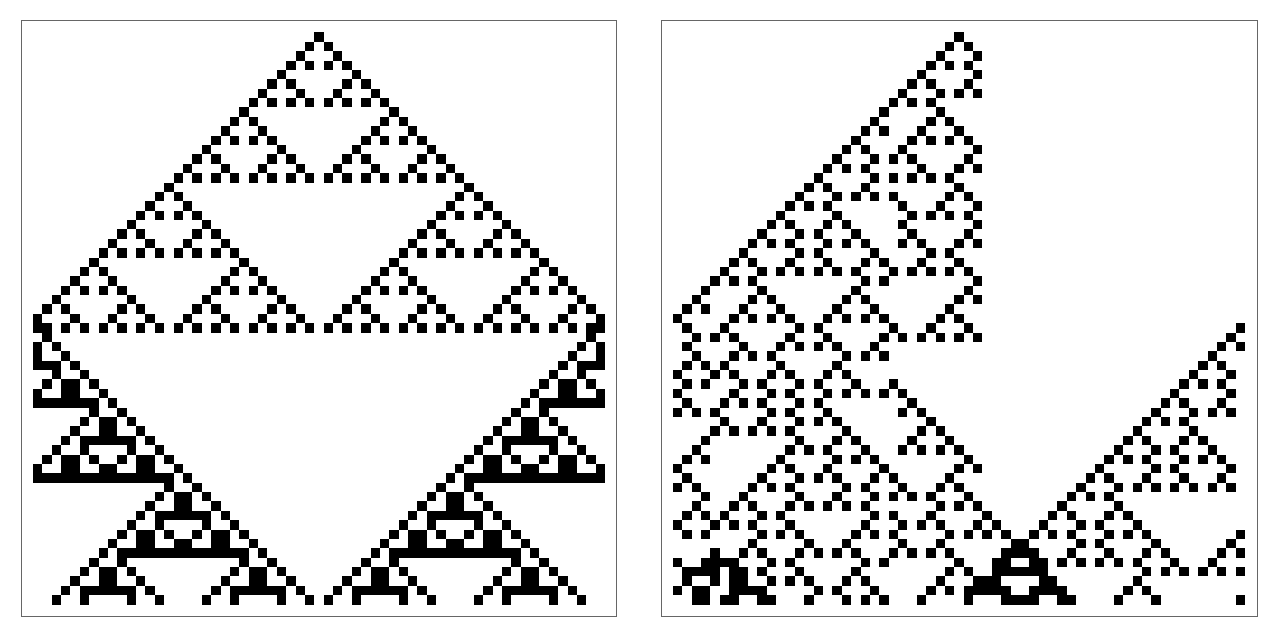
Rewire a few inputs of a rule 90 cellular automaton on a ring and compare the evolutions:
Evolution of some Boolean networks in which each automaton has three inputs:
















![ResourceFunction["AutomataNetworkRun"][
Table[{{{x__} :> Boole[Total[{x}] >= 2]}, {Mod[i - 2, 6] + 1, i, Mod[i, 6] + 1}, i}, {i, 6}], {1, 1, 0, 1, 0, 0}, 3]](https://www.wolframcloud.com/obj/resourcesystem/images/e41/e4136bae-e96c-4c82-8ba0-3f7b72006ca5/4d70fa5148c2f31c.png)



































![GraphicsRow[
ArrayPlot[
ResourceFunction["AutomataNetworkRun"][
Table[{rule90, #[[i]], i}, {i, 61}],
CenterArray[1, 61],
60]] & /@
{ringInputs, rewired}]](https://www.wolframcloud.com/obj/resourcesystem/images/e41/e4136bae-e96c-4c82-8ba0-3f7b72006ca5/3a4102a62e29d705.png)
![networks = Table[Table[{Thread[Tuples[{0, 1}, 3] -> RandomInteger[1, 8]], RandomInteger[{1, 40}, 3], i}, {i, 40}], 3];](https://www.wolframcloud.com/obj/resourcesystem/images/e41/e4136bae-e96c-4c82-8ba0-3f7b72006ca5/386d1f818f29c395.png)
![GraphicsRow[
ArrayPlot[
ResourceFunction["AutomataNetworkRun"][#, RandomInteger[1, 40], 40]] & /@ networks]](https://www.wolframcloud.com/obj/resourcesystem/images/e41/e4136bae-e96c-4c82-8ba0-3f7b72006ca5/794a01e8a0e2837c.png)