Wolfram Function Repository
Instant-use add-on functions for the Wolfram Language
Function Repository Resource:
Convert polylogarithmic functions and related zeta functions to inactive integral representations
ResourceFunction["PolyLogToIntegral"][expr] converts expr, such as a PolyLog,MultiplePolyLog,Zeta,HurwitzZeta,MultipleZeta,HarmonicPolyLog or GeneralizedPolyLog expression, to an inactive Integrate representation. |
Convert a classical polylogarithm to an iterated inactive integral:
| In[1]:= | ![ResourceFunction["PolyLogToIntegral"][PolyLog[3, 1/2]]](https://www.wolframcloud.com/obj/resourcesystem/images/11d/11d59ea9-b22b-4dce-8a60-ec5a96539ddd/0d707597bd0be310.png) |
| Out[1]= |  |
| In[2]:= | ![Activate[%] == PolyLog[3, 1/2]](https://www.wolframcloud.com/obj/resourcesystem/images/11d/11d59ea9-b22b-4dce-8a60-ec5a96539ddd/340dcda837c76bf2.png) |
| Out[2]= |  |
Convert a harmonic polylogarithm with indices -1, 0 and 1 to an iterated integral:
| In[3]:= | ![ResourceFunction["PolyLogToIntegral"][HarmonicPolyLog[{-1, 0, 1}, 1/2]]](https://www.wolframcloud.com/obj/resourcesystem/images/11d/11d59ea9-b22b-4dce-8a60-ec5a96539ddd/3b13a5f72619e767.png) |
| Out[3]= |  |
| In[4]:= | ![Activate[%] == HarmonicPolyLog[{-1, 0, 1}, 1/2] // Simplify](https://www.wolframcloud.com/obj/resourcesystem/images/11d/11d59ea9-b22b-4dce-8a60-ec5a96539ddd/67445e649463b6ec.png) |
| Out[4]= |  |
Convert a Riemann zeta value to its standard iterated integral form:
| In[5]:= | ![ResourceFunction["PolyLogToIntegral"][Zeta[7]]](https://www.wolframcloud.com/obj/resourcesystem/images/11d/11d59ea9-b22b-4dce-8a60-ec5a96539ddd/58c5927cf96a9f70.png) |
| Out[5]= |  |
| In[6]:= | ![Activate[%] == Zeta[7]](https://www.wolframcloud.com/obj/resourcesystem/images/11d/11d59ea9-b22b-4dce-8a60-ec5a96539ddd/4c6563adfd4ff736.png) |
| Out[6]= |  |
Convert a Hurwitz zeta value; the shift parameter appears in the resulting integrand:
| In[7]:= | ![ResourceFunction["PolyLogToIntegral"][HurwitzZeta[3, 6]]](https://www.wolframcloud.com/obj/resourcesystem/images/11d/11d59ea9-b22b-4dce-8a60-ec5a96539ddd/6d20d9baf8f07220.png) |
| Out[7]= | 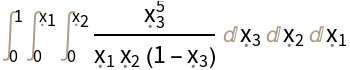 |
| In[8]:= | ![Activate[%] == HurwitzZeta[3, 6] // FullSimplify](https://www.wolframcloud.com/obj/resourcesystem/images/11d/11d59ea9-b22b-4dce-8a60-ec5a96539ddd/71f4a7b12e10bb45.png) |
| Out[8]= |  |
Convert a depth-two multiple zeta value to a nested integral representation:
| In[9]:= | ![ResourceFunction["PolyLogToIntegral"][MultipleZeta[{2, 6}]]](https://www.wolframcloud.com/obj/resourcesystem/images/11d/11d59ea9-b22b-4dce-8a60-ec5a96539ddd/781e2226e4cedada.png) |
| Out[9]= |  |
| In[10]:= | ![Activate[%] == MultipleZeta[{2, 6}]](https://www.wolframcloud.com/obj/resourcesystem/images/11d/11d59ea9-b22b-4dce-8a60-ec5a96539ddd/6ade246dc76d12bd.png) |
| Out[10]= |  |
Complex polylogarithm arguments are carried into the integral representation:
| In[11]:= | ![ResourceFunction["PolyLogToIntegral"][PolyLog[3, I]]](https://www.wolframcloud.com/obj/resourcesystem/images/11d/11d59ea9-b22b-4dce-8a60-ec5a96539ddd/55045c7ef7589b90.png) |
| Out[11]= |  |
| In[12]:= | ![Activate[%] == PolyLog[3, I]](https://www.wolframcloud.com/obj/resourcesystem/images/11d/11d59ea9-b22b-4dce-8a60-ec5a96539ddd/2ace875e9151b682.png) |
| Out[12]= |  |
A three-argument PolyLog expression is also converted to an inactive integral:
| In[13]:= | ![ResourceFunction["PolyLogToIntegral"][PolyLog[3, 2, I]]](https://www.wolframcloud.com/obj/resourcesystem/images/11d/11d59ea9-b22b-4dce-8a60-ec5a96539ddd/0327c5cd38536d78.png) |
| Out[13]= |  |
| In[14]:= | ![Activate[%] == PolyLog[3, 2, I]](https://www.wolframcloud.com/obj/resourcesystem/images/11d/11d59ea9-b22b-4dce-8a60-ec5a96539ddd/3bf41e08e50e5f04.png) |
| Out[14]= |  |
Convert a multiple polylogarithm with rational colors to an iterated integral:
| In[15]:= | ![ResourceFunction["PolyLogToIntegral"][
MultiplePolyLog[{2, 3}, {1/5, 1/7}]]](https://www.wolframcloud.com/obj/resourcesystem/images/11d/11d59ea9-b22b-4dce-8a60-ec5a96539ddd/5b98c28cf3cd566a.png) |
| Out[15]= |  |
| In[16]:= | ![Activate[%] == MultiplePolyLog[{2, 3}, {1/5, 1/7}]](https://www.wolframcloud.com/obj/resourcesystem/images/11d/11d59ea9-b22b-4dce-8a60-ec5a96539ddd/50d2872d4389a556.png) |
| Out[16]= |  |
Harmonic polylogarithms with larger signed indices are converted using the corresponding kernel factors:
| In[17]:= | ![ResourceFunction["PolyLogToIntegral"][HarmonicPolyLog[{-3, 2, 1}, 1/2]]](https://www.wolframcloud.com/obj/resourcesystem/images/11d/11d59ea9-b22b-4dce-8a60-ec5a96539ddd/65925e08d1fe1609.png) |
| Out[17]= |  |
| In[18]:= | ![Activate[%] == HarmonicPolyLog[{-3, 2, 1}, 1/2]](https://www.wolframcloud.com/obj/resourcesystem/images/11d/11d59ea9-b22b-4dce-8a60-ec5a96539ddd/38dccae345b08e60.png) |
| Out[18]= |  |
Convert a generalized polylogarithm to its inactive integral representation:
| In[19]:= | ![ResourceFunction["PolyLogToIntegral"][
GeneralizedPolyLog[{1, 2, 3, 4}, 1/2]]](https://www.wolframcloud.com/obj/resourcesystem/images/11d/11d59ea9-b22b-4dce-8a60-ec5a96539ddd/4c0ec1057ca8308d.png) |
| Out[19]= |  |
| In[20]:= | ![Activate[%] == GeneralizedPolyLog[{1, 2, 3, 4}, 1/2]](https://www.wolframcloud.com/obj/resourcesystem/images/11d/11d59ea9-b22b-4dce-8a60-ec5a96539ddd/453783d7e5b69a7a.png) |
| Out[20]= |  |
Inactive GeneralizedPolyLog input can also be converted, while the returned representation remains an inactive integral:
| In[21]:= | ![ResourceFunction["PolyLogToIntegral"][
Inactive[GeneralizedPolyLog][{1, 2, 3, 4}, 1/2]]](https://www.wolframcloud.com/obj/resourcesystem/images/11d/11d59ea9-b22b-4dce-8a60-ec5a96539ddd/15e3d2c54fbeb6ae.png) |
| Out[21]= |  |
| In[22]:= | ![Activate[%] == GeneralizedPolyLog[{1, 2, 3, 4}, 1/2]](https://www.wolframcloud.com/obj/resourcesystem/images/11d/11d59ea9-b22b-4dce-8a60-ec5a96539ddd/3b081a486e248ac6.png) |
| Out[22]= |  |
This work is licensed under a Creative Commons Attribution 4.0 International License