Wolfram Function Repository
Instant-use add-on functions for the Wolfram Language
Function Repository Resource:
Compute the multiple polylogarithm star function
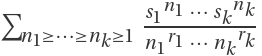
ResourceFunction["MultiplePolyLogStar"][{r1,r2,…,rk},{s1,s2,…,sk}] gives the multiple polylogarithm star function defined by the weakly ordered nested sum |
 .
.Exact values are generated automatically for simple arguments:
| In[1]:= | ![ResourceFunction["MultiplePolyLogStar"][{1, 1}, {1/2, 1/3}]](https://www.wolframcloud.com/obj/resourcesystem/images/261/261bca9f-dfc1-4f11-866e-792dabe9b011/0df2e71ee458d2a5.png) |
| Out[1]= |  |
Discretely sample across the first index with decoration values fixed:
| In[2]:= | ![DiscretePlot[
ResourceFunction["MultiplePolyLogStar"][{z, 1}, {1/2, 1/3}], {z, 1, 10}]](https://www.wolframcloud.com/obj/resourcesystem/images/261/261bca9f-dfc1-4f11-866e-792dabe9b011/3ca82d55196b2119.png) |
| Out[2]= | 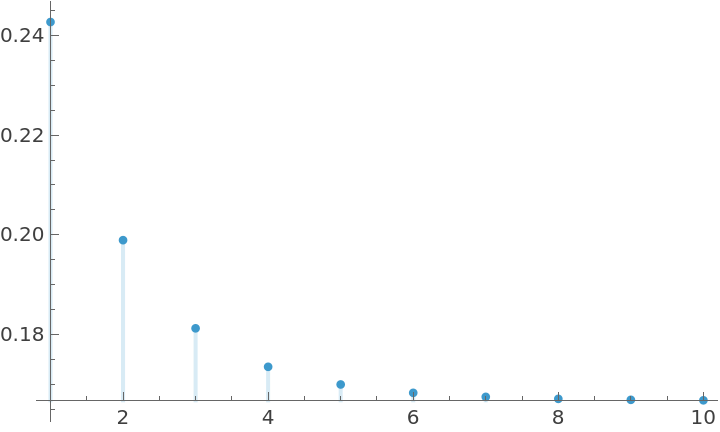 |
Plot along a real slice of a decoration value:
| In[3]:= | ![Plot[ResourceFunction[
"MultiplePolyLogStar"][{1, 1}, {1/2, x}], {x, -1, 1}]](https://www.wolframcloud.com/obj/resourcesystem/images/261/261bca9f-dfc1-4f11-866e-792dabe9b011/24c82fa146627d53.png) |
| Out[3]= | 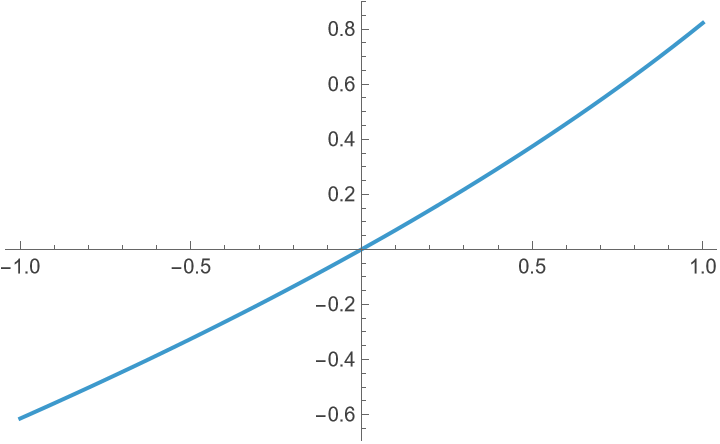 |
Evaluate numerically:
| In[4]:= | ![N[ResourceFunction["MultiplePolyLogStar"][{2, 4, 6}, {1/2, 1/3, 1/4}]]](https://www.wolframcloud.com/obj/resourcesystem/images/261/261bca9f-dfc1-4f11-866e-792dabe9b011/224b9dc526aef11d.png) |
| Out[4]= |  |
Evaluate to high precision:
| In[5]:= | ![N[ResourceFunction[
"MultiplePolyLogStar"][{2, 4, 6}, {1/2, 1/3, 1/4}], 20]](https://www.wolframcloud.com/obj/resourcesystem/images/261/261bca9f-dfc1-4f11-866e-792dabe9b011/3e1f53134e44fc6a.png) |
| Out[5]= |  |
Evaluate numerically with a complex decoration value:
| In[6]:= | ![N[ResourceFunction["MultiplePolyLogStar"][{2, 3}, {1/2 + I/3, 1/4}]]](https://www.wolframcloud.com/obj/resourcesystem/images/261/261bca9f-dfc1-4f11-866e-792dabe9b011/7caeaa682a003947.png) |
| Out[6]= |  |
Evaluate at decoration values {1, -1}:
| In[7]:= | ![ResourceFunction["MultiplePolyLogStar"][{2, 1}, {1, -1}]](https://www.wolframcloud.com/obj/resourcesystem/images/261/261bca9f-dfc1-4f11-866e-792dabe9b011/651c7a5ca4089258.png) |
| Out[7]= |  |
Evaluate at conjugate decoration values {-I,I}:
| In[8]:= | ![ResourceFunction["MultiplePolyLogStar"][{2, 1}, {-I, I}]](https://www.wolframcloud.com/obj/resourcesystem/images/261/261bca9f-dfc1-4f11-866e-792dabe9b011/73fad95251e6c762.png) |
| Out[8]= |  |
A MultiplePolyLogStar with negative integers and zeros as the indices evaluates to a rational number:
| In[9]:= | ![ResourceFunction["MultiplePolyLogStar"][{-2, 0, 0}, {1/2, -1/2, 1/3}]](https://www.wolframcloud.com/obj/resourcesystem/images/261/261bca9f-dfc1-4f11-866e-792dabe9b011/770680bd2c8d100c.png) |
| Out[9]= |  |
A zero in the decoration list makes the MultiplePolyLogStar vanish identically:
| In[10]:= | ![ResourceFunction[
"MultiplePolyLogStar"][{6, 2, 3, 4}, {-I, 0, 1/2, -1/2}]](https://www.wolframcloud.com/obj/resourcesystem/images/261/261bca9f-dfc1-4f11-866e-792dabe9b011/31be99792e484d60.png) |
| Out[10]= |  |
A divergent MultiplePolyLogStar:
| In[11]:= | ![ResourceFunction["MultiplePolyLogStar"][{2, 3}, {6, 10}]](https://www.wolframcloud.com/obj/resourcesystem/images/261/261bca9f-dfc1-4f11-866e-792dabe9b011/751ce7e6ca4840d8.png) |
| Out[11]= |  |
Discrete plot of the diagonal depth-2 values across positive n, highlighting rapid decay with increasing weight:
| In[12]:= | ![DiscretePlot[
ResourceFunction["MultiplePolyLogStar"][{n, n}, {1/2, 1/3}], {n, 1, 10}]](https://www.wolframcloud.com/obj/resourcesystem/images/261/261bca9f-dfc1-4f11-866e-792dabe9b011/6e06ed49077fe28b.png) |
| Out[12]= | 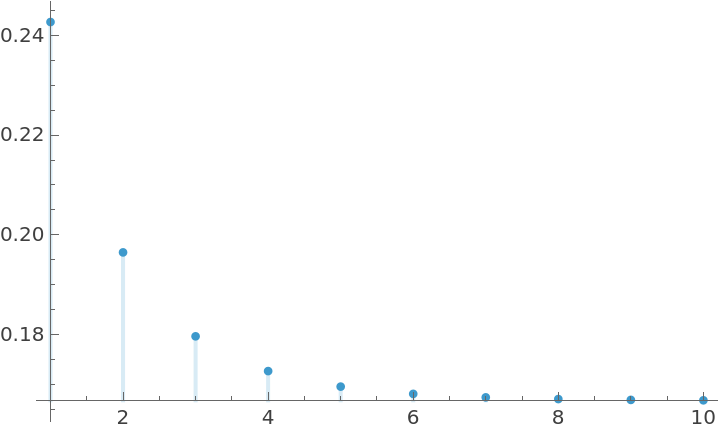 |
Discretely sample a MultiplePolyLogStar across integer (positive/zero/negative) indices:
| In[13]:= | ![DiscretePlot[
Log10@ResourceFunction[
"MultiplePolyLogStar"][{n, 1}, {1/2, 1/3}], {n, -10, 10}]](https://www.wolframcloud.com/obj/resourcesystem/images/261/261bca9f-dfc1-4f11-866e-792dabe9b011/00f47e689a372aa5.png) |
| Out[13]= | 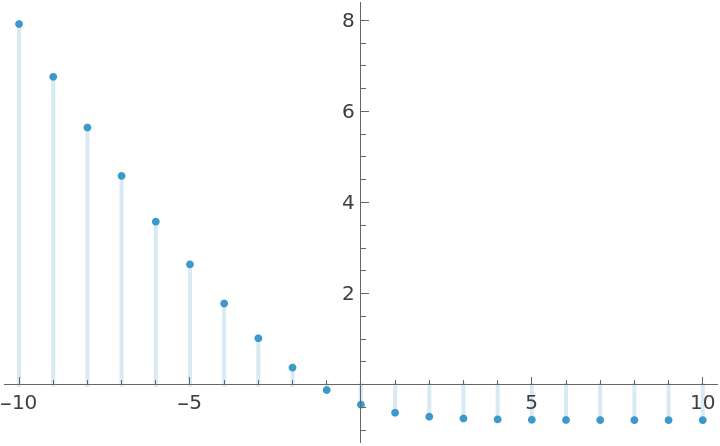 |
Side-by-side traces of MultiplePolyLogStar[{n,2},{1/2,1/3}] and MultiplePolyLogStar[{2,n},{1/2,1/3}] that emphasize order asymmetry under index swap:
| In[14]:= | ![DiscretePlot[
Evaluate@{ResourceFunction["MultiplePolyLogStar"][{n, 2}, {1/2, 1/3}],
ResourceFunction["MultiplePolyLogStar"][{2, n}, {1/2, 1/3}]}, {n, 2, 20}, Sequence[ScalingFunctions -> {None, "Log"}, PlotStyle -> {
Directive[Thick,
RGBColor[0., 0.619, 0.451]],
Directive[Thick,
RGBColor[0.8, 0.475, 0.655]]}]]](https://www.wolframcloud.com/obj/resourcesystem/images/261/261bca9f-dfc1-4f11-866e-792dabe9b011/21dfb7f995326e98.png) |
| Out[14]= | 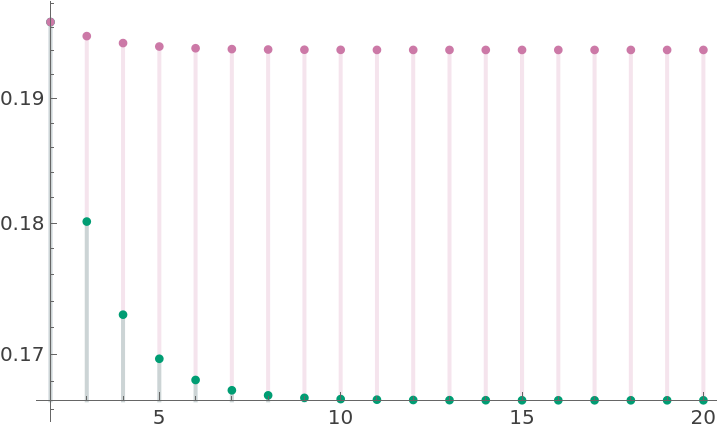 |
Discrete 3-D bars of Log10[MultiplePolyLogStar[{z1,z2},{1/2,1/3}]] over positive indices, showing how magnitude varies across the grid:
| In[15]:= | ![DiscretePlot3D[
Abs@Log10@
ResourceFunction["MultiplePolyLogStar"][{z1, z2}, {1/2, 1/3}], {z1,
1, 8}, {z2, 1, 8}, Sequence[
ExtentSize -> Full, ColorFunction -> "NeonColors", AxesLabel -> Automatic]]](https://www.wolframcloud.com/obj/resourcesystem/images/261/261bca9f-dfc1-4f11-866e-792dabe9b011/3201da9ff7ede627.png) |
| Out[15]= | 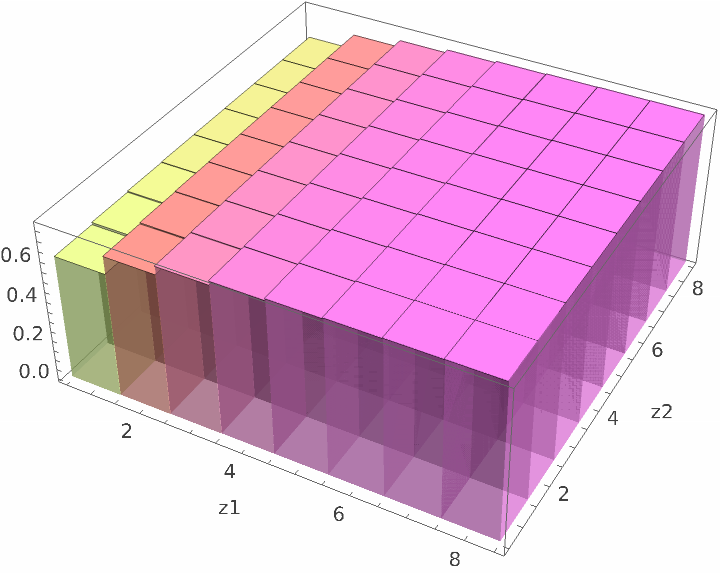 |
Plot along a real slice of a decoration value for a depth-three MultiplePolyLog:
| In[16]:= | ![Plot[ResourceFunction[
"MultiplePolyLogStar"][{2, 3, 4}, {s, 1/3, 1/6}], {s, -1/2, 1/2}]](https://www.wolframcloud.com/obj/resourcesystem/images/261/261bca9f-dfc1-4f11-866e-792dabe9b011/144da7dbf505936e.png) |
| Out[16]= | 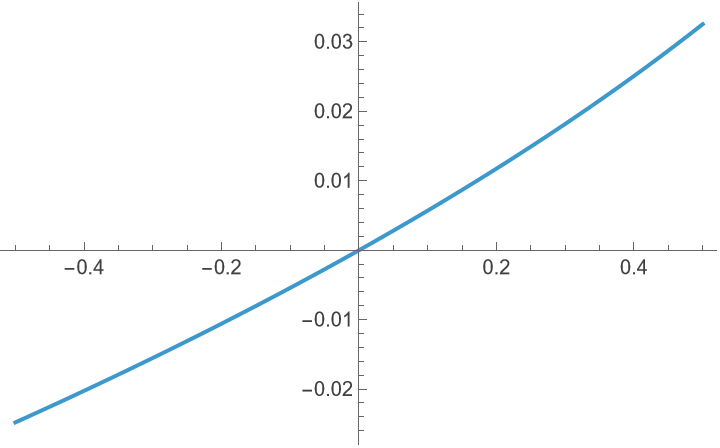 |
Visualize the dependence on two decoration values for a depth-two MultiplePolyLog:
| In[17]:= | ![Plot3D[ResourceFunction[
"MultiplePolyLogStar"][{3, 2}, {s1, s2}], {s1, -1/2, 1/2}, {s2, -1/2, 1/2}, Sequence[
PlotRange -> All, ColorFunction -> "AlpineColors", ColorFunctionScaling -> False, Mesh -> 12, MeshStyle -> Directive[White,
Opacity[0.25]], Lighting -> "Neutral", BoxRatios -> {1, 1, 0.6}, AxesLabel -> Map[Style[#, 12,
GrayLevel[0.25]]& , {"s1", "s2"}], LabelStyle -> Directive[
GrayLevel[0.2], 12], ImageMargins -> 10, ImagePadding -> 20, ClippingStyle -> None]]](https://www.wolframcloud.com/obj/resourcesystem/images/261/261bca9f-dfc1-4f11-866e-792dabe9b011/355960330e271f75.png) |
| Out[17]= | 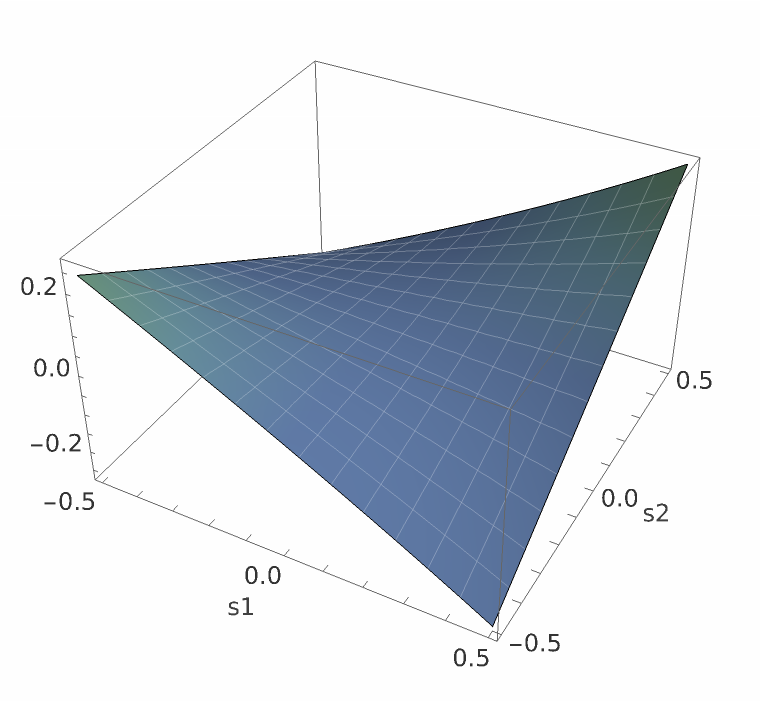 |
Render a complex surface over a rectangular region of the decoration s-plane:
| In[18]:= | ![ComplexPlot3D[
ResourceFunction[
"MultiplePolyLogStar"][{2, 3}, {s, 1/3}], {s, -1/2 - I/2, 1/2 + I/2}]](https://www.wolframcloud.com/obj/resourcesystem/images/261/261bca9f-dfc1-4f11-866e-792dabe9b011/7e827be694f02f29.png) |
| Out[18]= | 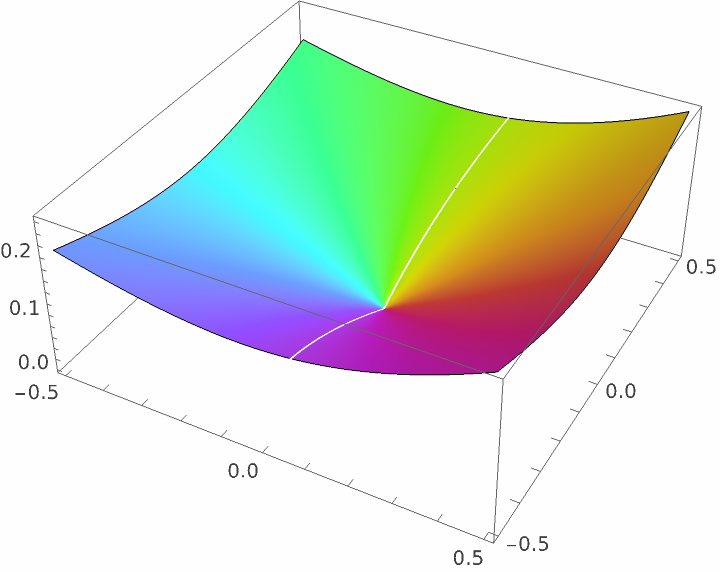 |
Depth-1 convergent MultiplePolyLogStar is same as MultiplePolyLog and PolyLog:
| In[19]:= | ![ResourceFunction["MultiplePolyLogStar"][{10}, {1/3}] == MultiplePolyLog[{10}, {1/3}] == PolyLog[10, 1/3]](https://www.wolframcloud.com/obj/resourcesystem/images/261/261bca9f-dfc1-4f11-866e-792dabe9b011/4091ccd492e0d8d2.png) |
| Out[19]= |  |
A convergent MultiplePolyLogStar can be written as a linear combination of MultiplePolyLog's:
| In[20]:= | ![Inactive[
ResourceFunction["MultiplePolyLogStar"]][{2, 3, 4}, {1/2, 1/3, 1/6}] ==
Sum[((1/2)^n1 (1/3)^n2 (1/6)^n3)/(
n1^2 n2^3 n3^4), {n1, 1, Infinity}, {n2, 1, n1}, {n3, 1, n2}]](https://www.wolframcloud.com/obj/resourcesystem/images/261/261bca9f-dfc1-4f11-866e-792dabe9b011/5f3e16e0213b955f.png) |
| Out[20]= |  |
Verify the identity numerically:
| In[21]:= | ![N[Activate[%]]](https://www.wolframcloud.com/obj/resourcesystem/images/261/261bca9f-dfc1-4f11-866e-792dabe9b011/721f34b1d1d14f9b.png) |
| Out[21]= |  |
When all decoration values are 1, MultiplePolyLogStar gives a multiple zeta star value:
| In[22]:= | ![ResourceFunction["MultiplePolyLogStar"][{2, 3}, {1, 1}]](https://www.wolframcloud.com/obj/resourcesystem/images/261/261bca9f-dfc1-4f11-866e-792dabe9b011/6eb143616a7f150f.png) |
| Out[22]= |  |
When all the decoration values are either 1 or -1, MultiplePolyLogStar reduces to combinations of HarmonicPolyLog:
| In[23]:= | ![ResourceFunction[
"MultiplePolyLogStar"][{3, 6, 10, 2, 1}, {1, -1, -1, 1, -1}]](https://www.wolframcloud.com/obj/resourcesystem/images/261/261bca9f-dfc1-4f11-866e-792dabe9b011/5e9792a62d776a48.png) |
| Out[23]= |  |
Both arguments must be lists:
| In[24]:= | ![ResourceFunction["MultiplePolyLogStar"][2, {1/2}]](https://www.wolframcloud.com/obj/resourcesystem/images/261/261bca9f-dfc1-4f11-866e-792dabe9b011/69277a1074bcdd54.png) |
| Out[24]= |  |
The two lists must have the same length:
| In[25]:= | ![ResourceFunction["MultiplePolyLogStar"][{2, 3, 4}, {1/2, 1/3}]](https://www.wolframcloud.com/obj/resourcesystem/images/261/261bca9f-dfc1-4f11-866e-792dabe9b011/4b6f973bdc5259bc.png) |
| Out[25]= |  |
This work is licensed under a Creative Commons Attribution 4.0 International License