Details
A point c is pre-periodic if it iterates eventually to a periodic point. For example, if c=-2 and starting with z=0 then f(z) has the sequence (0,-2,2,2,2,…). The values 0 and -2 are pre-periodic, and the value 2 is periodic.
All Misiurewicz points lie on the boundary of the Mandelbrot set but are specifically excluded from the centers of hyperbolic components.
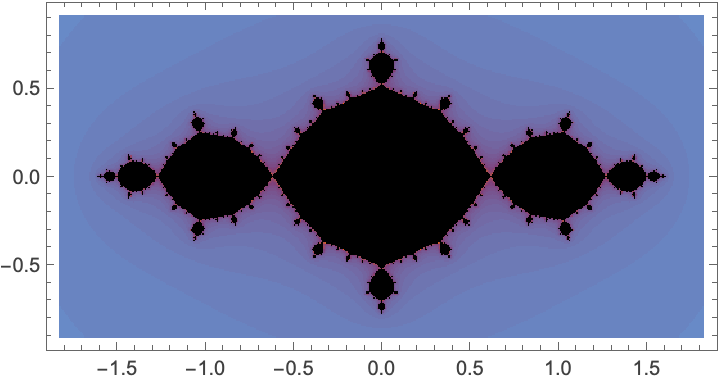
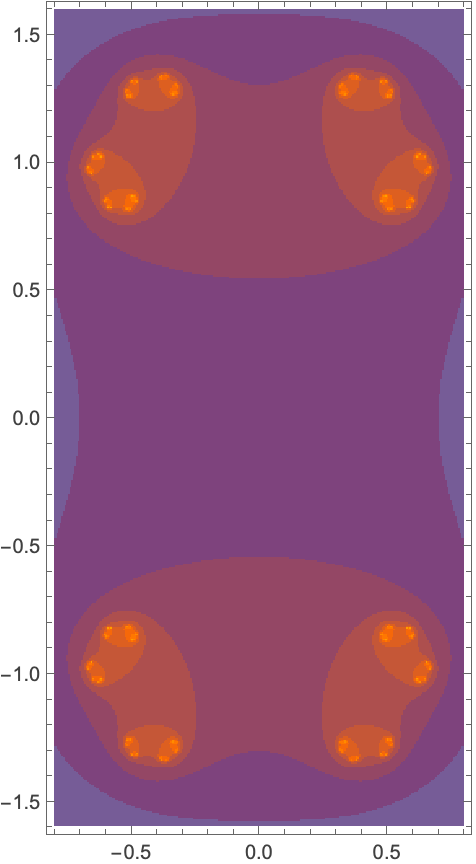
At a Misiurewicz point c, the corresponding Julia set is connected, contains no interior, and admits no attracting periodic cycles, making the dynamics purely chaotic.
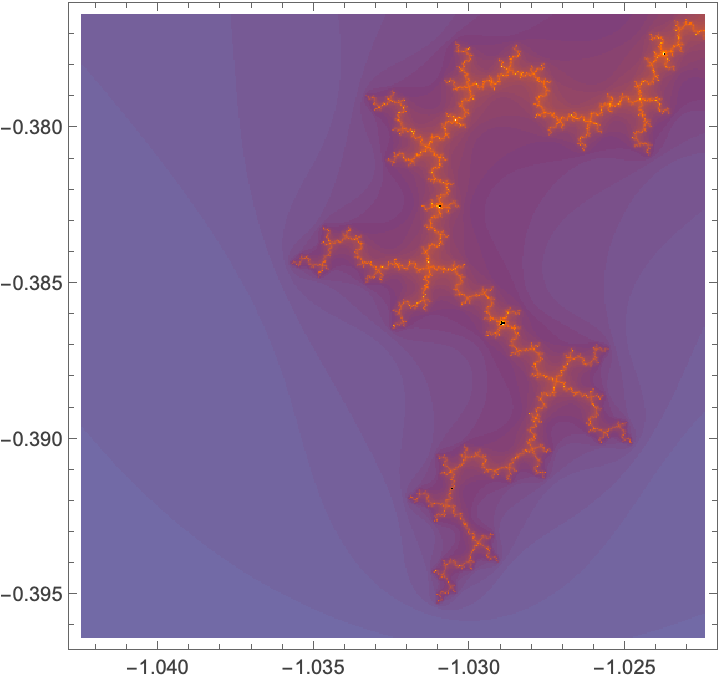
Misiurewicz points are dense in the boundary of the Mandelbrot set, often serving as the "tips" of filaments or junctions where branches of the set meet.
The function solves a polynomial equation zm+k(c)=zm(c) where the degree grows exponentially as 2m+k-1, leading to a significant increase in computational complexity for large values of m and k.
Michał Misiurewicz is a Polish-American mathematician renowned for his contributions to chaos theory and dynamical systems, specifically for defining the parameters in the Mandelbrot set where the critical point is strictly pre-periodic but not periodic.
![ResourceFunction["MisiurewiczPoints"][2, 2]](https://www.wolframcloud.com/obj/resourcesystem/images/2cd/2cd640ff-a60c-4040-a6eb-820bc980df36/37067e1c27e57682.png)

![ResourceFunction["MisiurewiczPoints"][0, 3]](https://www.wolframcloud.com/obj/resourcesystem/images/2cd/2cd640ff-a60c-4040-a6eb-820bc980df36/3009b098d6daa0f8.png)

![ResourceFunction["MisiurewiczPoints"][2, 5]](https://www.wolframcloud.com/obj/resourcesystem/images/2cd/2cd640ff-a60c-4040-a6eb-820bc980df36/2fa79a83ac2886a8.png)
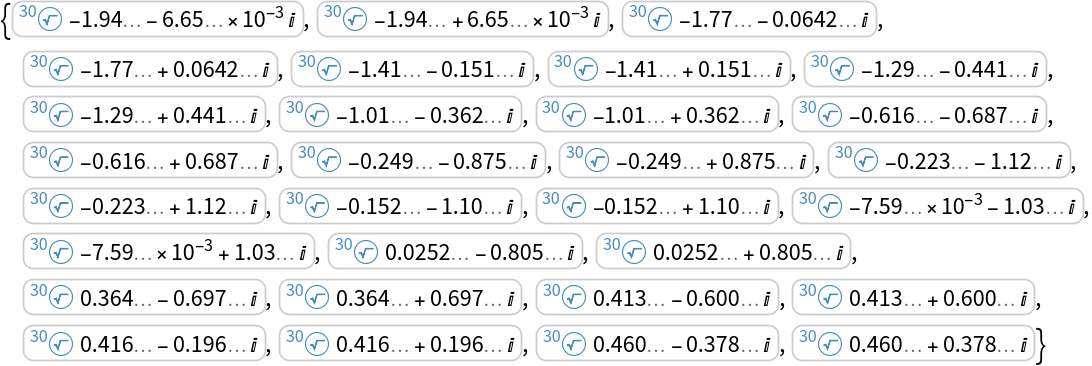
![ComplexListPlot[ResourceFunction["MisiurewiczPoints"][2, 5]]](https://www.wolframcloud.com/obj/resourcesystem/images/2cd/2cd640ff-a60c-4040-a6eb-820bc980df36/384e3df621a931e7.png)
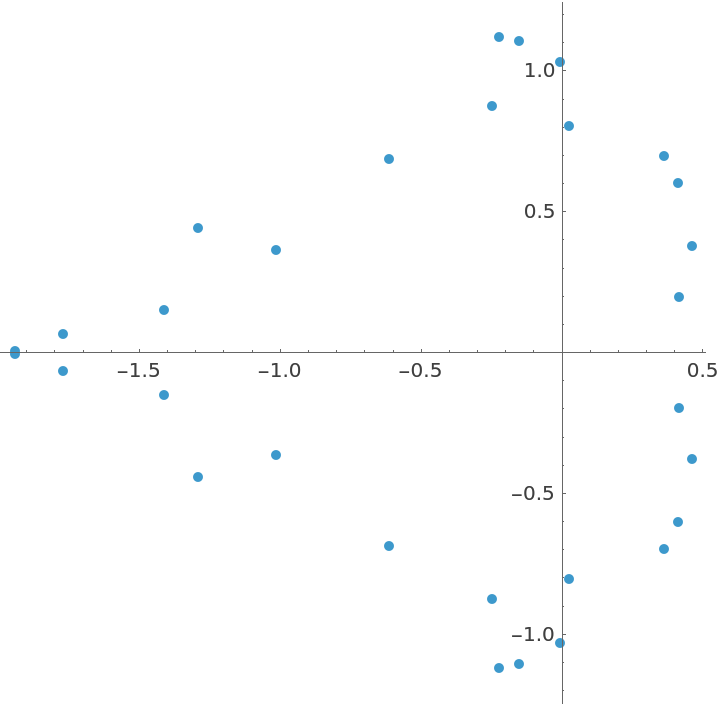
![ComplexListPlot[ResourceFunction["MisiurewiczPoints"][3, 6]]](https://www.wolframcloud.com/obj/resourcesystem/images/2cd/2cd640ff-a60c-4040-a6eb-820bc980df36/3a132a3654097275.png)
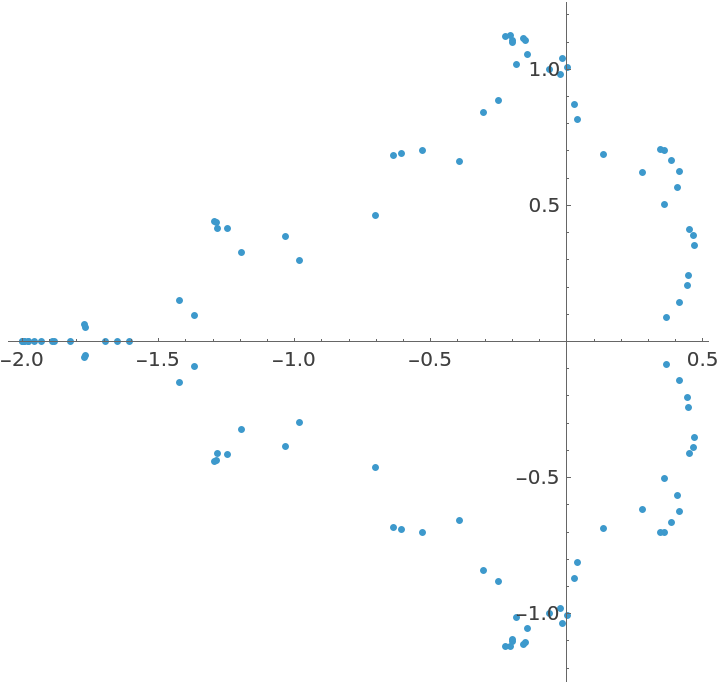
![SeedRandom[0];
p = RandomChoice[ResourceFunction["MisiurewiczPoints"][4, 4]]](https://www.wolframcloud.com/obj/resourcesystem/images/2cd/2cd640ff-a60c-4040-a6eb-820bc980df36/4d2b71ee68da6d13.png)

![JuliaSetPlot[p, MaxIterations -> 300]](https://www.wolframcloud.com/obj/resourcesystem/images/2cd/2cd640ff-a60c-4040-a6eb-820bc980df36/4dcbead055a7db79.png)
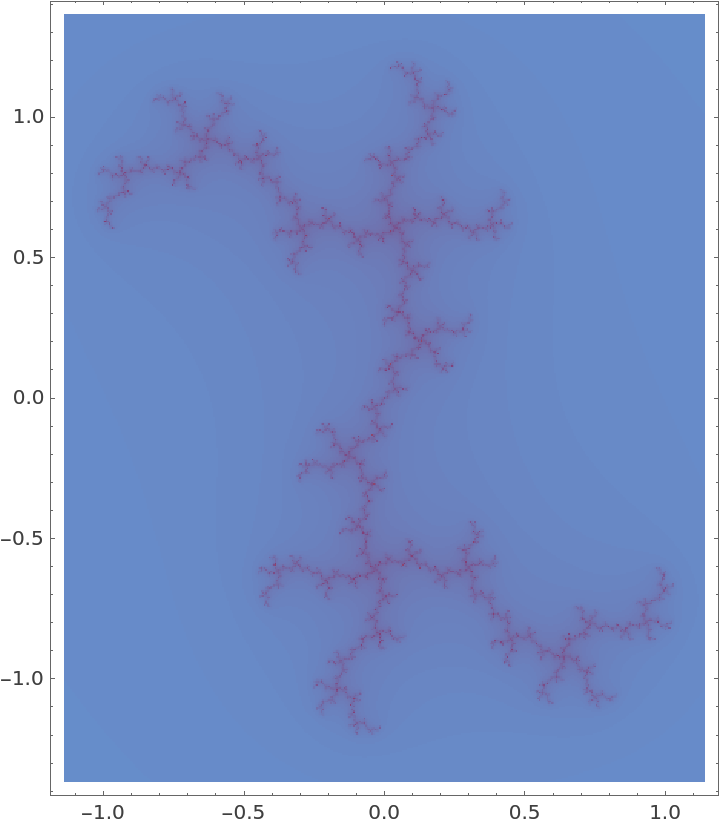
![JuliaSetPlot[-1]](https://www.wolframcloud.com/obj/resourcesystem/images/2cd/2cd640ff-a60c-4040-a6eb-820bc980df36/769845822c8eb1f3.png)
![JuliaSetPlot[1, MaxIterations -> 20]](https://www.wolframcloud.com/obj/resourcesystem/images/2cd/2cd640ff-a60c-4040-a6eb-820bc980df36/6a3f331ba8213fa0.png)
![z = RandomChoice[ResourceFunction["MisiurewiczPoints"][3, 6]]](https://www.wolframcloud.com/obj/resourcesystem/images/2cd/2cd640ff-a60c-4040-a6eb-820bc980df36/5f8e5a1d2a0f0c39.png)

![r = 1.0 + 1.0 I;
MandelbrotSetPlot[{z - 0.01 r, z + 0.01 r}]](https://www.wolframcloud.com/obj/resourcesystem/images/2cd/2cd640ff-a60c-4040-a6eb-820bc980df36/1c462f3b9e376fc6.png)
![AnimationVideo[
MandelbrotSetPlot[{z - r 2^-t, z + r 2^-t}, Sequence[
Frame -> False, Axes -> False, PlotRangePadding -> None]], {t, 0, 10}]](https://www.wolframcloud.com/obj/resourcesystem/images/2cd/2cd640ff-a60c-4040-a6eb-820bc980df36/78054441a92e44a7.png)