Wolfram Function Repository
Instant-use add-on functions for the Wolfram Language
Function Repository Resource:
Generalized Gell-Mann matrix
ResourceFunction["GellMannMatrix"][n,i] returns generalized ith Gell-Mann matrix of dimension n. | |
ResourceFunction["GellMannMatrix"][n] returns all n2-1 Gell-Mann matrices of dimension n. |
| Automatic | automatically choose the representation returned |
| "Dense" | represent the matrix as a dense array |
| "Sparse" | represent the matrix as a sparse array |
| "Structured" | represent the matrix as a structured array |
Construct generalized Gell-Mann matrices for n=4:
| In[1]:= | ![MatrixForm /@ ResourceFunction["GellMannMatrix"][4]](https://www.wolframcloud.com/obj/resourcesystem/images/b53/b5312923-65e6-419b-a159-076b0544431a/245284cad8cad89d.png) |
| Out[1]= | 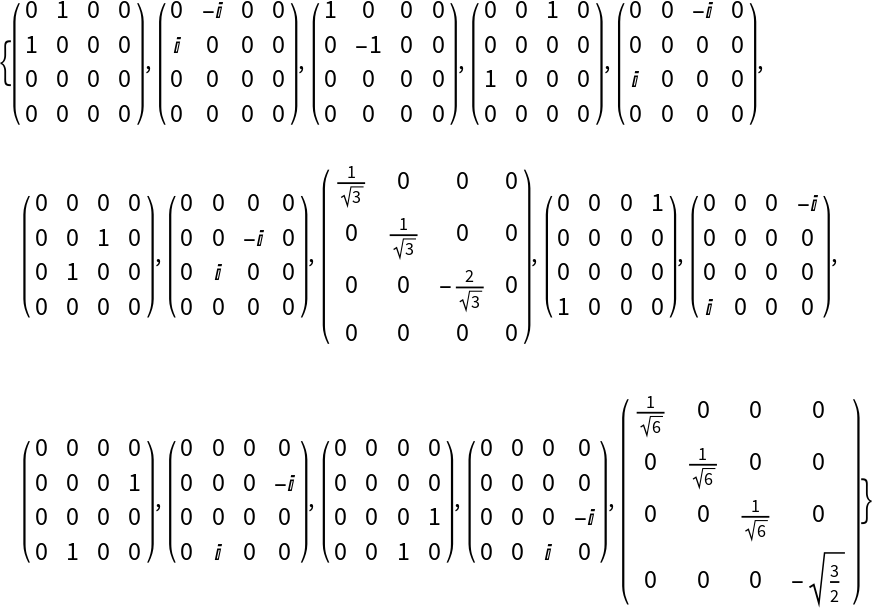 |
Construct the first generalized Gell-Mann matrices for n=5:
| In[2]:= | ![MatrixForm@ResourceFunction["GellMannMatrix"][5, 1]](https://www.wolframcloud.com/obj/resourcesystem/images/b53/b5312923-65e6-419b-a159-076b0544431a/4afd186b5da51e0b.png) |
| Out[2]= |  |
Gell-Mann matrices are generator of SU(2):
| In[3]:= | ![MatrixForm /@ ResourceFunction["GellMannMatrix"][2]](https://www.wolframcloud.com/obj/resourcesystem/images/b53/b5312923-65e6-419b-a159-076b0544431a/0d73ecc6fbe32018.png) |
| Out[3]= |  |
The standard Gell-Mann matrices are 8 generators of SU(3):
| In[4]:= | ![MatrixForm /@ ResourceFunction["GellMannMatrix"][3]](https://www.wolframcloud.com/obj/resourcesystem/images/b53/b5312923-65e6-419b-a159-076b0544431a/09f727aba90249de.png) |
| Out[4]= |  |
Gell-Mann matrices are given as sparse arrays by default:
| In[5]:= | ![ResourceFunction["GellMannMatrix"][5, 3]](https://www.wolframcloud.com/obj/resourcesystem/images/b53/b5312923-65e6-419b-a159-076b0544431a/5a48dc50703e0e84.png) |
| Out[5]= |  |
Use the option TargetStructure to get them in different formats:
| In[6]:= | ![ResourceFunction["GellMannMatrix"][5, 3, TargetStructure -> #] & /@ {Automatic, "Sparse", "Dense", "Structured"}](https://www.wolframcloud.com/obj/resourcesystem/images/b53/b5312923-65e6-419b-a159-076b0544431a/5f8c226d65cfd244.png) |
| Out[6]= | 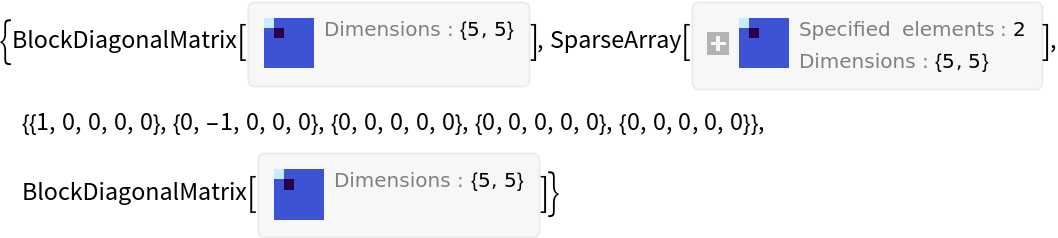 |
Gell-Mann matrices of dimension 2 are the Pauli matrices:
| In[7]:= | ![ResourceFunction["GellMannMatrix"][2] == PauliMatrix[Range[3]]](https://www.wolframcloud.com/obj/resourcesystem/images/b53/b5312923-65e6-419b-a159-076b0544431a/0e1022ea354d094f.png) |
| Out[7]= |  |
Number of generalized Gell-Mann matrices is n2-1:
| In[8]:= | ![Table[Length@ResourceFunction["GellMannMatrix"][n] == n^2 - 1, {n, 2, 6}]](https://www.wolframcloud.com/obj/resourcesystem/images/b53/b5312923-65e6-419b-a159-076b0544431a/4d20913d326d6181.png) |
| Out[8]= |  |
Gell-Mann matrices are Hermitian  :
:
| In[9]:= | ![Table[And @@ (HermitianMatrixQ /@ ResourceFunction["GellMannMatrix"][n]), {n, 2, 6}]](https://www.wolframcloud.com/obj/resourcesystem/images/b53/b5312923-65e6-419b-a159-076b0544431a/793cde39bc8c40a1.png) |
| Out[9]= |  |
The matrices ⅈλi are anti-Hermitian:
| In[10]:= | ![Table[And @@ (AntihermitianMatrixQ /@ (I ResourceFunction[
"GellMannMatrix"][n])), {n, 2, 6}]](https://www.wolframcloud.com/obj/resourcesystem/images/b53/b5312923-65e6-419b-a159-076b0544431a/13db6a620498ed1e.png) |
| Out[10]= |  |
Gell-Mann matrices are traceless Tr[λa]=0:
| In[11]:= | ![Union[Flatten[
Table[Tr /@ ResourceFunction["GellMannMatrix"][n], {n, 2, 6}]]] == {0}](https://www.wolframcloud.com/obj/resourcesystem/images/b53/b5312923-65e6-419b-a159-076b0544431a/6227e700d907b2fd.png) |
| Out[11]= |  |
Gell-Mann matrices form an orthonormal set with respect to the Hilbert-Schmidt inner product, ie Tr[λiλj]=2δij:
| In[12]:= | ![n = 4; d = n^2 - 1;
\[ScriptCapitalG] = ResourceFunction["GellMannMatrix"][n];
Outer[Tr[#1 . #2] &, \[ScriptCapitalG], \[ScriptCapitalG], 1] == 2 IdentityMatrix[d]](https://www.wolframcloud.com/obj/resourcesystem/images/b53/b5312923-65e6-419b-a159-076b0544431a/3ae4cd09916cce10.png) |
| Out[14]= |  |
Find the structure constants:

| In[15]:= | ![\[Lambda]n = ResourceFunction["GellMannMatrix"][4];
fabc = Outer[
1/(4 I) Tr[(#1 . #2 - #2 . #1) . #3] &, \[Lambda]n, \[Lambda]n, \[Lambda]n, 1];](https://www.wolframcloud.com/obj/resourcesystem/images/b53/b5312923-65e6-419b-a159-076b0544431a/63f178ea6c8f3385.png) |

| In[16]:= | ![dabc = Outer[
1/4 Tr[(#1 . #2 + #2 . #1) . #3] &, \[Lambda]n, \[Lambda]n, \[Lambda]n, 1];](https://www.wolframcloud.com/obj/resourcesystem/images/b53/b5312923-65e6-419b-a159-076b0544431a/7242e1754de1661d.png) |
Verify symmetric and antisymmetric features of structure constants:
| In[17]:= | ![fabc == -Transpose[fabc] // FullSimplify](https://www.wolframcloud.com/obj/resourcesystem/images/b53/b5312923-65e6-419b-a159-076b0544431a/1d9073a175f8eb9e.png) |
| Out[17]= |  |
| In[18]:= | ![dabc == Transpose[dabc] // FullSimplify](https://www.wolframcloud.com/obj/resourcesystem/images/b53/b5312923-65e6-419b-a159-076b0544431a/419ecc50c807b748.png) |
| Out[18]= |  |
Verify[λi,λj]=2ⅈ∑kfijkλk:
| In[19]:= | ![\[Lambda]n = ResourceFunction["GellMannMatrix"][5];
fabc = Outer[
1/(4 I) Tr[(#1 . #2 - #2 . #1) . #3] &, \[Lambda]n, \[Lambda]n, \[Lambda]n, 1];
Outer[#1 . #2 - #2 . #1 &, \[Lambda]n, \[Lambda]n, 1] == 2 I TensorContract[TensorProduct[fabc, \[Lambda]n], {{3, 4}}]](https://www.wolframcloud.com/obj/resourcesystem/images/b53/b5312923-65e6-419b-a159-076b0544431a/16d0387a8fdccc1c.png) |
| Out[16]= |  |
Verify  :
:
| In[20]:= | ![n = 7; d = n^2 - 1;
\[Lambda]n = ResourceFunction["GellMannMatrix"][n];
dabc = Outer[
1/4 Tr[(#1 . #2 + #2 . #1) . #3] &, \[Lambda]n, \[Lambda]n, \[Lambda]n, 1];
Outer[#1 . #2 + #2 . #1 &, \[Lambda]n, \[Lambda]n, 1] == 4/n Outer[Times, IdentityMatrix[d], IdentityMatrix[n]] + 2 TensorContract[TensorProduct[dabc, \[Lambda]n], {{3, 4}}]](https://www.wolframcloud.com/obj/resourcesystem/images/b53/b5312923-65e6-419b-a159-076b0544431a/23a2f2112531c1f5.png) |
| Out[17]= |  |
Verify product rule  :
:
| In[21]:= | ![n = 5; d = n^2 - 1;
\[Lambda]n = ResourceFunction["GellMannMatrix"][n];
fabc = Outer[
1/(4 I) Tr[(#1 . #2 - #2 . #1) . #3] &, \[Lambda]n, \[Lambda]n, \[Lambda]n, 1];
dabc = Outer[
1/4 Tr[(#1 . #2 + #2 . #1) . #3] &, \[Lambda]n, \[Lambda]n, \[Lambda]n, 1];
Outer[#1 . #2 &, \[Lambda]n, \[Lambda]n, 1] == 2/n Outer[Times, IdentityMatrix[d], IdentityMatrix[n]] + TensorContract[TensorProduct[dabc + I fabc, \[Lambda]n], {{3, 4}}]](https://www.wolframcloud.com/obj/resourcesystem/images/b53/b5312923-65e6-419b-a159-076b0544431a/764b74b1ea34e676.png) |
| Out[18]= |  |
Verify quadratic Casimir (fundamental rep) 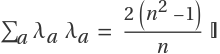 :
:
| In[22]:= | ![n = 7;
\[Lambda]n = ResourceFunction["GellMannMatrix"][n];
Sum[l . l, {l, \[Lambda]n}] == (2 (n^2 - 1))/n IdentityMatrix[n]](https://www.wolframcloud.com/obj/resourcesystem/images/b53/b5312923-65e6-419b-a159-076b0544431a/40e99ced8ca8b0b4.png) |
| Out[16]= |  |
The second argument should be a positive integer less than n2-1 for n the first argument:
| In[23]:= | ![ResourceFunction["GellMannMatrix"][3, 10]](https://www.wolframcloud.com/obj/resourcesystem/images/b53/b5312923-65e6-419b-a159-076b0544431a/48129467c46c8b7f.png) |
| Out[23]= |  |
The first argument n should be positive integer and the 2nd argument a positive integer less than n2-1 for n the first argument:
| In[24]:= | ![ResourceFunction["GellMannMatrix"][3, -1]](https://www.wolframcloud.com/obj/resourcesystem/images/b53/b5312923-65e6-419b-a159-076b0544431a/4d5a6a9b815bc113.png) |
| Out[24]= |  |
| In[25]:= | ![ResourceFunction["GellMannMatrix"][3., 1]](https://www.wolframcloud.com/obj/resourcesystem/images/b53/b5312923-65e6-419b-a159-076b0544431a/34dbc0655a68be57.png) |
| Out[25]= |  |
Possible settings for TargetStructure for constructing matrices include Automatic, "Dense", "Sparse", and "Structured":
| In[26]:= | ![ResourceFunction["GellMannMatrix"][3, 1, TargetStructure -> HankelMatrix]](https://www.wolframcloud.com/obj/resourcesystem/images/b53/b5312923-65e6-419b-a159-076b0544431a/7675df976f7f9800.png) |
| Out[26]= |  |
This work is licensed under a Creative Commons Attribution 4.0 International License



