Wolfram Function Repository
Instant-use add-on functions for the Wolfram Language
Function Repository Resource:
Compute the Galois group of an irreducible polynomial
ResourceFunction["GaloisGroup"][poly] gives properties about the Galois group for the polynomial poly up to degree 7. | |
ResourceFunction["GaloisGroup"][] gives tabular data of properties for all possible Galois groups for polynomials up to degree 7. |
| "nTk" | k-th transitive subgroup of Sn |
| "Order" | order of a Galois group |
| "Attributes" | attributes of this Galois group |
| "Name" | common name of this Galois group |
| "PermutationGroupRepresentation" | representation as a Wolfram System permutation group |
| "Generators" | generators of this Galois group |
Calculate the Galois group of a polynomial:
| In[1]:= | ![ResourceFunction["GaloisGroup"][x^5 - 5 x^3 + 5 x - 4]](https://www.wolframcloud.com/obj/resourcesystem/images/ffd/ffddac48-9b11-4869-a9b3-1a048a984e52/092c72311a591e89.png) |
| Out[1]= |  |
Calculate the Galois group of a fourth-order polynomial:
| In[2]:= | ![ResourceFunction["GaloisGroup"][x^4 + 2 x^2 + 2]](https://www.wolframcloud.com/obj/resourcesystem/images/ffd/ffddac48-9b11-4869-a9b3-1a048a984e52/36e547657695da9a.png) |
| Out[2]= |  |
Return all possible Galois groups of degree up to 7:
| In[3]:= | ![ResourceFunction["GaloisGroup"][]](https://www.wolframcloud.com/obj/resourcesystem/images/ffd/ffddac48-9b11-4869-a9b3-1a048a984e52/60b9f7cfc57b425b.png) |
| Out[3]= | 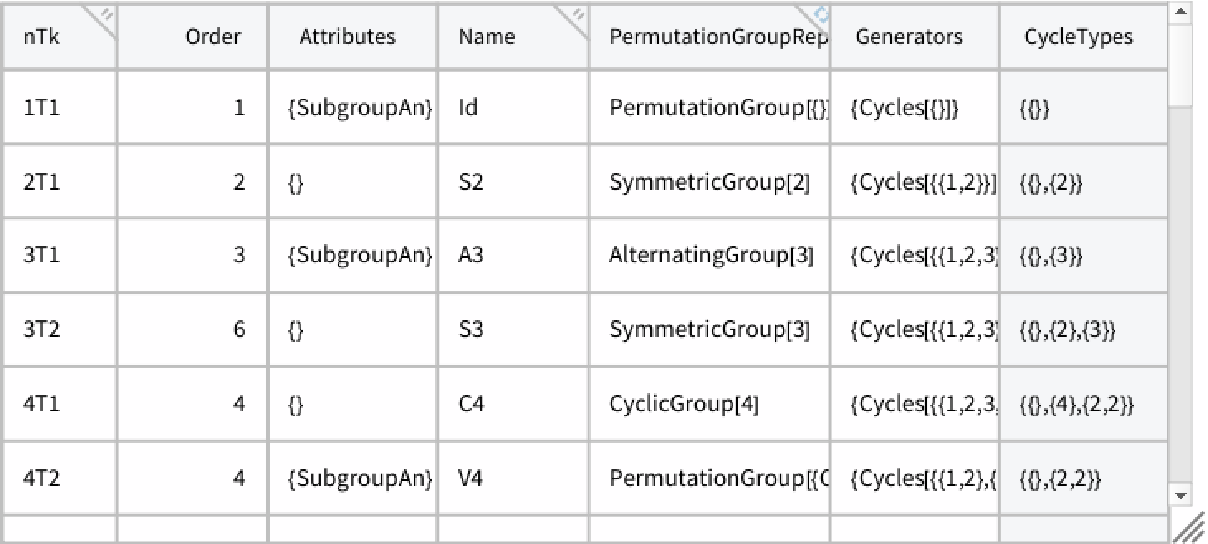 |
The coefficients of the polynomial can be rational numbers:
| In[4]:= | ![ResourceFunction["GaloisGroup"][x^2/6 + x/3 + 1/10]](https://www.wolframcloud.com/obj/resourcesystem/images/ffd/ffddac48-9b11-4869-a9b3-1a048a984e52/0010acfd9ebd4cb1.png) |
| Out[4]= |  |
| In[5]:= | ![polys = {x^4 - 2, x^5 - x - 1, x^5 - 2, x^6 - 3 x^3 + 1, x^4 - 10 x^2 + 1, -1 - x + x^7};
Table[{p, ResourceFunction["GaloisGroup"][p]}, {p, polys}]](https://www.wolframcloud.com/obj/resourcesystem/images/ffd/ffddac48-9b11-4869-a9b3-1a048a984e52/47cb5bdd67d8a023.png) |
| Out[6]= |  |
When a polynomial is reducible in the rational number field, it will return unevaluated:
| In[7]:= | ![poly = -18 - 3 x - 3 x^2 - x^3 + x^4;
IrreduciblePolynomialQ[poly]](https://www.wolframcloud.com/obj/resourcesystem/images/ffd/ffddac48-9b11-4869-a9b3-1a048a984e52/77b5dcb7f5acb94b.png) |
| Out[8]= |  |
| In[9]:= | ![ResourceFunction["GaloisGroup"][-18 - 3 x - 3 x^2 - x^3 + x^4]](https://www.wolframcloud.com/obj/resourcesystem/images/ffd/ffddac48-9b11-4869-a9b3-1a048a984e52/0a66da50f5d26cce.png) |
| Out[9]= |  |
This work is licensed under a Creative Commons Attribution 4.0 International License