Wolfram Function Repository
Instant-use add-on functions for the Wolfram Language
Function Repository Resource:
Turn polylines into woven bands
ResourceFunction["BandWeaver"][polylines,halfwidth] returns polygon bands of twice a given halfwidth for an over/under weaving of self-intersecting polylines. |
Turn a polyline into woven bands:
| In[1]:= | ![polyline = {{0, 0}, {6, 0}, {6, 9}, {3, 9}, {3, 3}, {9, 3}, {9, 6}, {0, 6}, {0, 0}};
bands = ResourceFunction["BandWeaver"][polyline, 1]](https://www.wolframcloud.com/obj/resourcesystem/images/49d/49d7f9e8-ef84-4d1f-9f95-5d03995e346f/76402b56e299fe9f.png) |
| Out[2]= |  |
Look at the polyline and the generated polygon bands:
| In[3]:= | ![Row[Flatten[
Join[{Graphics[{Line[polyline]}], Graphics[#] & /@ bands[[1]]}]]]](https://www.wolframcloud.com/obj/resourcesystem/images/49d/49d7f9e8-ef84-4d1f-9f95-5d03995e346f/4e89a05f90fafe13.png) |
| Out[3]= |  |
Look at the full woven band:
| In[4]:= | ![Graphics[{EdgeForm[{Black, Thick}], Cyan, bands}]](https://www.wolframcloud.com/obj/resourcesystem/images/49d/49d7f9e8-ef84-4d1f-9f95-5d03995e346f/08908659a99f7edd.png) |
| Out[4]= | 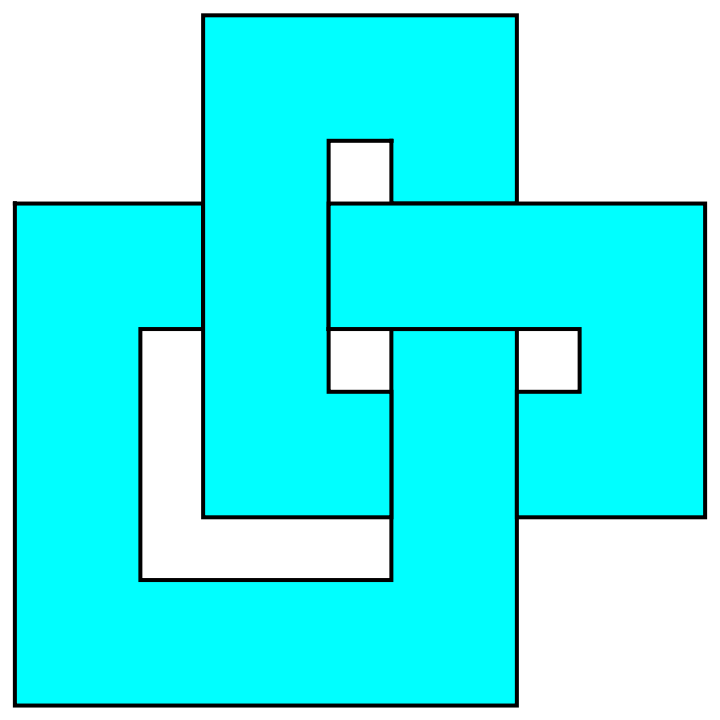 |
Show knight moves:
| In[5]:= | ![knight = {{0, 0}, {1, 2}, {2, 0}, {0, 1}, {2, 2}, {1, 0}, {0, 2}, {2, 1}, {0, 0}}; Graphics[{EdgeForm[{Black, Thick}], Red, ResourceFunction["BandWeaver"][knight, .06]}]](https://www.wolframcloud.com/obj/resourcesystem/images/49d/49d7f9e8-ef84-4d1f-9f95-5d03995e346f/100956069c3976cf.png) |
| Out[5]= | 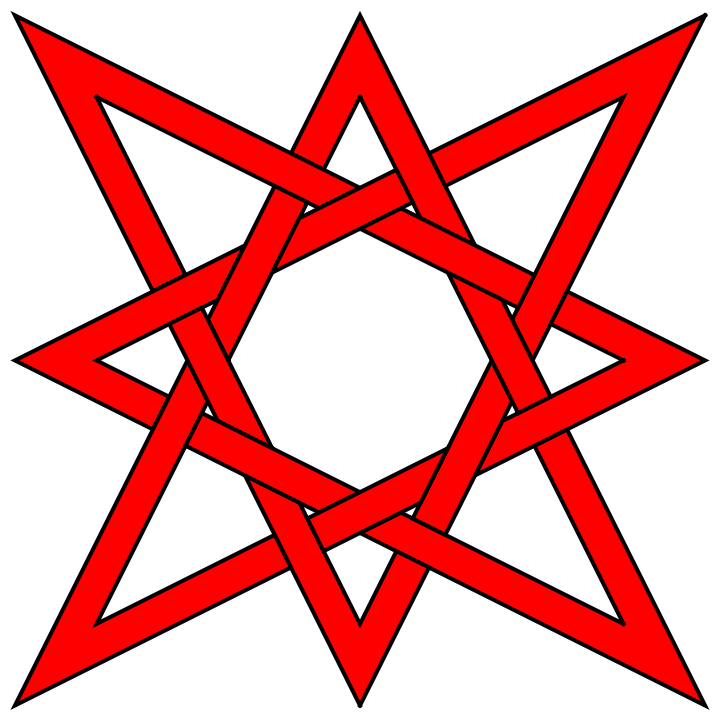 |
Results of BandWeaver can be combined with other graphics:
| In[6]:= | ![polyline = {{0, 0}, {2, 1}, {1, 0}, {0, 1}, {2, 0}, {1, 1}};
part = Partition[polyline, 2, 1, 1];
Graphics[{EdgeForm[{Gray, Thin}], Yellow, ResourceFunction["BandWeaver"][polyline, .05],
Blue, Table[Text[k, (3 part[[k, 1]] + 2 part[[k, 2]])/5], {k, 1, 6}]}]](https://www.wolframcloud.com/obj/resourcesystem/images/49d/49d7f9e8-ef84-4d1f-9f95-5d03995e346f/57f5efa1451aa09c.png) |
| Out[8]= | 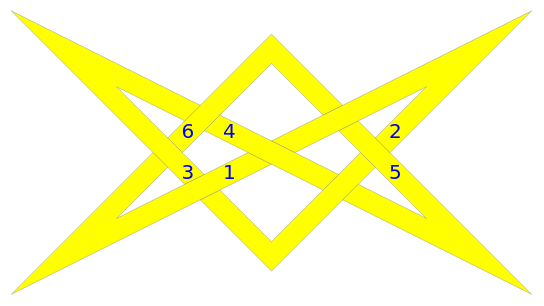 |
BandWeaver works for multiple polylines:
| In[9]:= | ![lines = 3 N[CirclePoints[9]][[#]] & /@ Transpose[Partition[Range[9], 3]];
bands = ResourceFunction["BandWeaver"][lines, .1];
Graphics[{EdgeForm[{Black, Thick}], Cyan, bands[[1]], Green, bands[[2]],
Blue, bands[[3]]}]](https://www.wolframcloud.com/obj/resourcesystem/images/49d/49d7f9e8-ef84-4d1f-9f95-5d03995e346f/0797acdd21b20dfc.png) |
| Out[11]= | 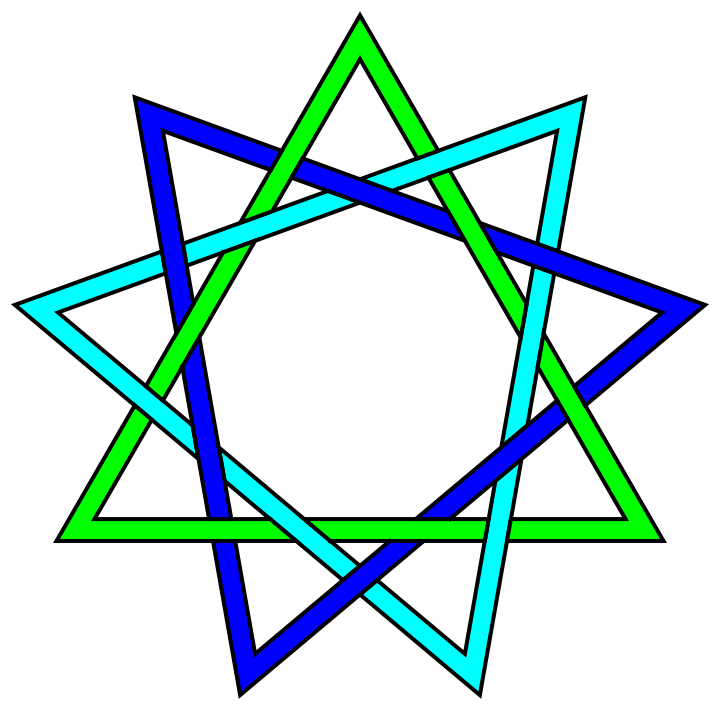 |
Code for a bouncing ball:
| In[12]:= | ![BouncePolyline45[w_, h_, p0_, dir_ : {1, 1}] := Module[{x = p0[[1]], y = p0[[2]], vx, vy, t = 0, T, pts, dx, dy, dt}, {vx, vy} = Sign[dir] /. 0 -> 1;
T = LCM[2 w, 2 h];(*for integer w,h;4\[Times]7\[RightArrow]56*)
pts = {{x, y}};
While[t < T, dx = If[vx > 0, w - x, x];
dy = If[vy > 0, h - y, y];
dt = Min[dx, dy, T - t];
x = x + vx dt; y = y + vy dt; t = t + dt;
pts = Append[pts, {x, y}];
If[dt === dx, vx = -vx];
If[dt === dy, vy = -vy];];
pts]
pts = BouncePolyline45[14, 8, {3, 0}, {1, 1}]](https://www.wolframcloud.com/obj/resourcesystem/images/49d/49d7f9e8-ef84-4d1f-9f95-5d03995e346f/56f5eee21d2e8115.png) |
| Out[13]= |  |
Let's make a Celtic weave out of it:
| In[14]:= | ![Graphics[{EdgeForm[{Black, Thick}], Green, ResourceFunction["BandWeaver"][pts, .4]}]](https://www.wolframcloud.com/obj/resourcesystem/images/49d/49d7f9e8-ef84-4d1f-9f95-5d03995e346f/5647c94f6e9d386c.png) |
| Out[14]= | 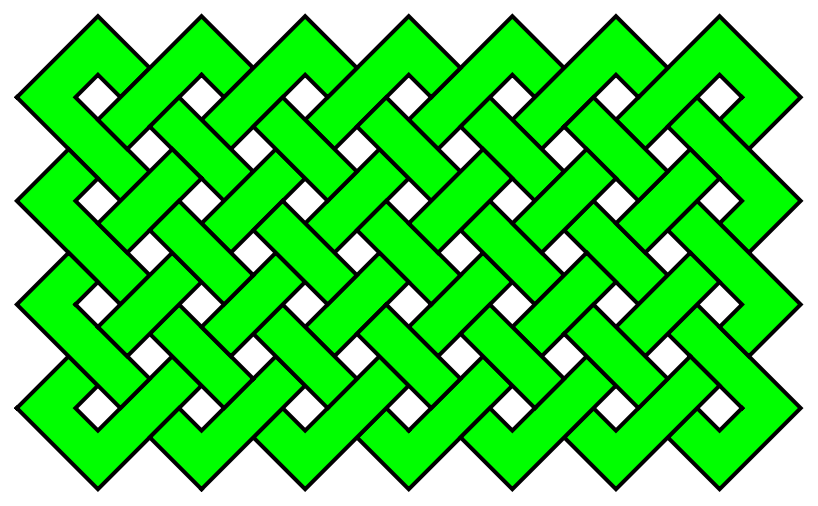 |
Let's try weaving some weaving:
| In[15]:= | ![pts = {{-.5, -.5}, {5, 5}, {8, 2}, {6, 0}, {1, 5}, {0, 4}, {4, 0}, {8,
4}, {7, 5}, {2, 0}, {0, 2}, {3, 5}, {8.5, -.5}};
bands = ResourceFunction[
"BandWeaver"][{pts, # {1, -1} + {2, 5} & /@ pts}, .18];
Graphics[{EdgeForm[{Black}], Green, bands[[1]], Cyan, bands[[2]]}]](https://www.wolframcloud.com/obj/resourcesystem/images/49d/49d7f9e8-ef84-4d1f-9f95-5d03995e346f/4dea2ce675c327a8.png) |
| Out[17]= | 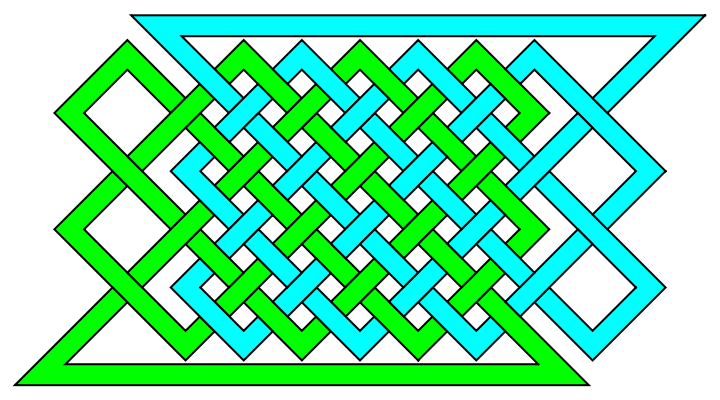 |
Whoops, got the wrong offset. Let's change a digit to shove that over:
| In[18]:= | ![bands = ResourceFunction[
"BandWeaver"][{pts, # {1, -1} + {0, 5} & /@ pts}, .18];
Graphics[{EdgeForm[{Black}], Green, bands[[1]], Cyan, bands[[2]]}]](https://www.wolframcloud.com/obj/resourcesystem/images/49d/49d7f9e8-ef84-4d1f-9f95-5d03995e346f/4964d9c87dc640ac.png) |
| Out[19]= | 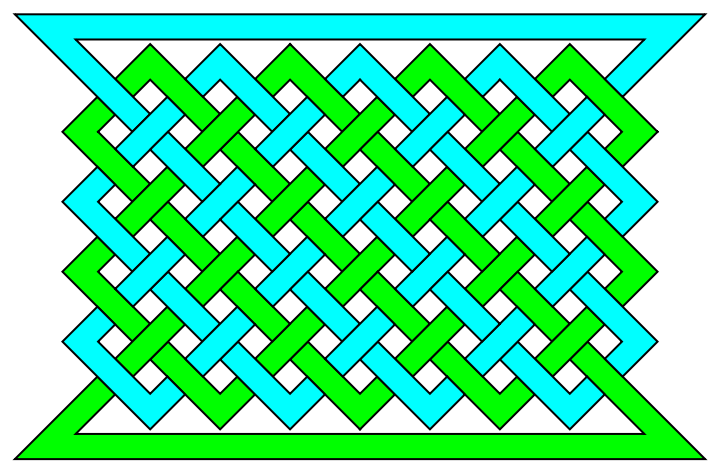 |
Show a knight's tour:
| In[20]:= | ![grid86 = Tuples[{Range[8], Range[6]}]; knighttour = grid86[[{1, 9, 5, 18, 29, 42, 46, 33, 41, 30, 17, 6, 10, 23, 12, 4, 15, 2, 13, 21, 25, 38, 27, 35, 48, 40, 44, 31, 20, 7, 3, 16, 8, 19,
32, 43, 39, 26, 37, 45, 34, 47, 36, 28, 24, 11, 22, 14}]];
Graphics[{EdgeForm[{Thin, Gray}], White, Rectangle /@ (grid86 - 1/2), EdgeForm[{Black, Thick}], Green, ResourceFunction["BandWeaver"][knighttour, .05]}]](https://www.wolframcloud.com/obj/resourcesystem/images/49d/49d7f9e8-ef84-4d1f-9f95-5d03995e346f/7abb39afb654406e.png) |
| Out[21]= | 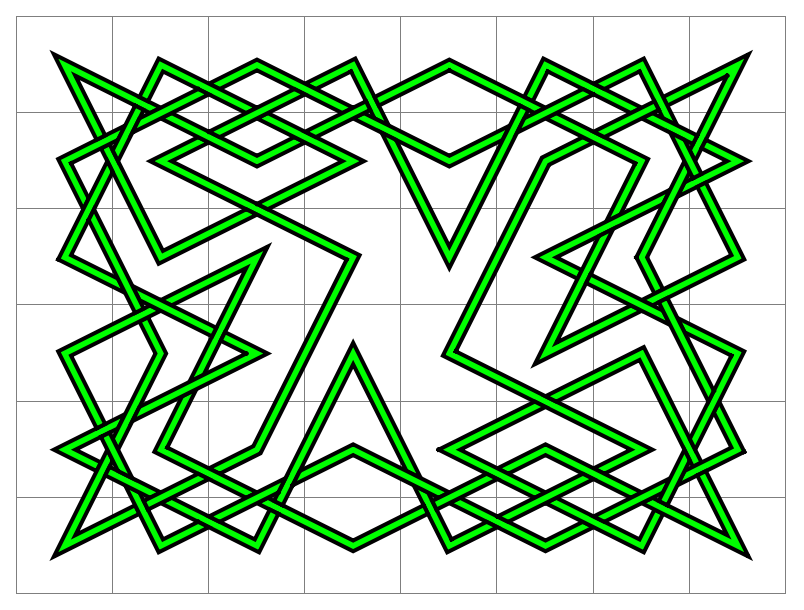 |
The possible band thickness is limited, most of the time:
| In[22]:= | ![polyline = {{0, 1}, {2, 0}, {1, 1}, {3, 2}, {2, 3}, {1, 2}, {3, 1}, {1, 0}, {2, 1}, {0, 2}, {1, 3}, {2, 2}, {0, 1}}; Graphics[{EdgeForm[{Black, Thick}], Green, ResourceFunction["BandWeaver"][polyline, .05]}]](https://www.wolframcloud.com/obj/resourcesystem/images/49d/49d7f9e8-ef84-4d1f-9f95-5d03995e346f/7e5c2f69b7ba8f00.png) |
| Out[22]= | 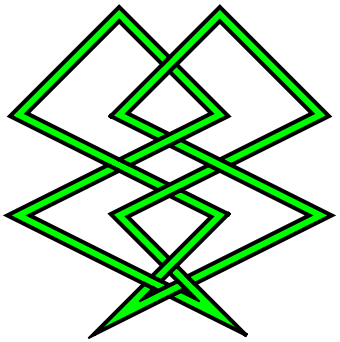 |
If the band is too wide, the code will fail in various ways:
| In[23]:= | ![ResourceFunction["BandWeaver"][polyline, .4]](https://www.wolframcloud.com/obj/resourcesystem/images/49d/49d7f9e8-ef84-4d1f-9f95-5d03995e346f/127f1344e32bb4a7.png) |
| Out[23]= |  |
Without self-intersection, the ResourceFunction PerforatePolygons is needed instead:
| In[24]:= | ![Graphics[{EdgeForm[{Black, Thick}], Green, ResourceFunction["BandWeaver"][{{0, 0}, {0, 1}, {1, 1}, {1, 0}}, .1]}]](https://www.wolframcloud.com/obj/resourcesystem/images/49d/49d7f9e8-ef84-4d1f-9f95-5d03995e346f/6ab12e142e5abda8.png) |
| Out[24]= | 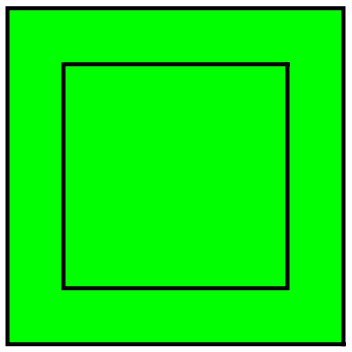 |
A single self-intersection is enough:
| In[25]:= | ![Graphics[{EdgeForm[{Black, Thick}], Green, ResourceFunction["BandWeaver"][{{0, 0}, {0, 1}, {1, 0}, {1, 1}}, .1]}]](https://www.wolframcloud.com/obj/resourcesystem/images/49d/49d7f9e8-ef84-4d1f-9f95-5d03995e346f/0b70ed2f69d48829.png) |
| Out[25]= |  |
Code for making star polylines:
| In[26]:= | ![StarPolyline[n_Integer?Positive, k_Integer] :=
CirclePoints[n][[#]] & /@ Table[NestList[Mod[# - 1 + Mod[k, n], n] + 1 &, s, n/GCD[n, Mod[k, n]] - 1], {s, 1, GCD[n, Mod[k, n]]}];](https://www.wolframcloud.com/obj/resourcesystem/images/49d/49d7f9e8-ef84-4d1f-9f95-5d03995e346f/3bd6768a3a05cffe.png) |
Weave together two 9-pointed stars:
| In[27]:= | ![pol = ResourceFunction["BandWeaver"][
N[Flatten[{-StarPolyline[9, 3], StarPolyline[9, 4]}, 1]], .017];
Graphics[{EdgeForm[{Black, Thick}], Green, Take[pol, 3], Cyan, pol[[4]]}]](https://www.wolframcloud.com/obj/resourcesystem/images/49d/49d7f9e8-ef84-4d1f-9f95-5d03995e346f/5455c1cccebbe66c.png) |
| Out[28]= | 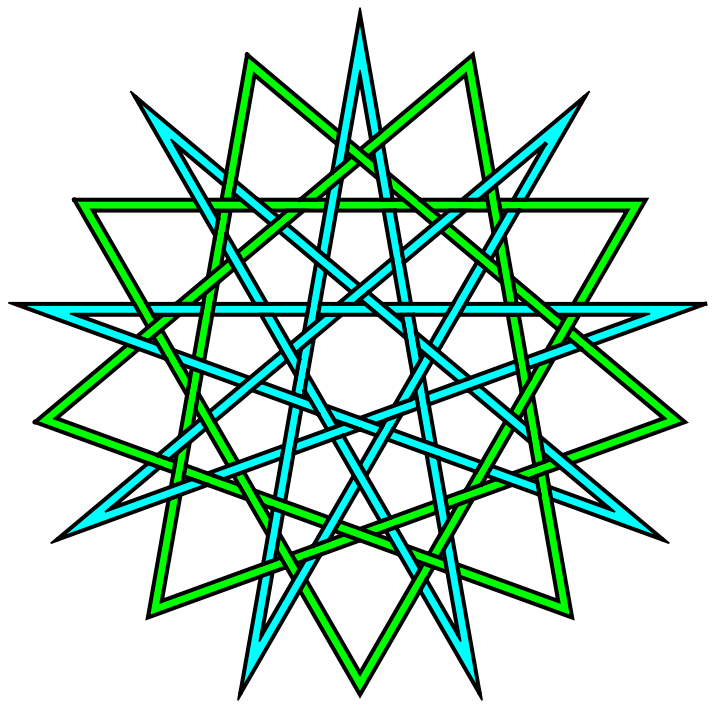 |
Still using the star code, make woven bands out of many stars:
| In[29]:= | ![stars = Flatten[
Table[Graphics[{EdgeForm[{Gray, Thin}], Yellow, ResourceFunction["BandWeaver"][N[StarPolyline[k, b]], 0.02]}, ImageSize -> 160], {k, 5, 13}, {b, 2, Min[Floor[(k - 1)/2], 4]}], 1];
Grid[Partition[stars, 5]]](https://www.wolframcloud.com/obj/resourcesystem/images/49d/49d7f9e8-ef84-4d1f-9f95-5d03995e346f/5e9128d888b334be.png) |
| Out[30]= | 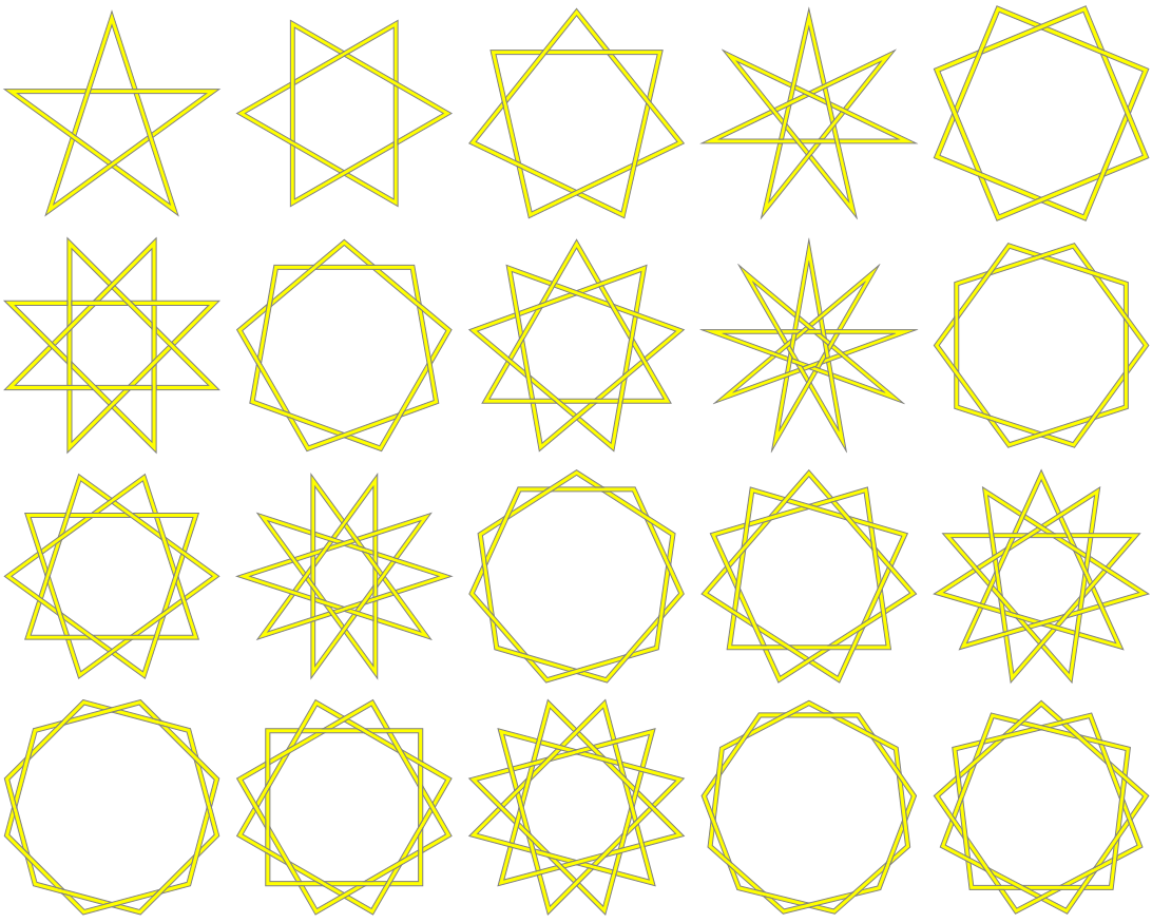 |
More elaborate star-like weavings:
| In[31]:= | ![oddstarsraw = {{1, 4, 11, 2, 9, 12, 7, 10, 5, 8, 3, 6}, {1, 6, 3, 8, 5, 10, 7, 12, 9, 14, 11, 2, 13, 4}, {1, 10, 7, 2, 13, 8, 5, 14, 11,
6, 3, 12, 9, 4}, {1, 4, 11, 14, 5, 8, 15, 2, 9, 12, 3, 6, 13, 16, 7, 10}, {1, 6, 15, 4, 13, 2, 11, 16, 9, 14, 7, 12, 5, 10, 3, 8}, {
1, 10, 7, 16, 13, 6, 3, 12, 9, 2, 15, 8, 5, 14, 11, 4}, {1, 4, 11, 14, 3, 6, 13, 16, 5, 8, 15, 18, 7, 10, 17, 2, 9, 12}, {1, 6, 15, 20, 9, 14, 3, 8, 17, 2, 11, 16, 5, 10, 19, 4, 13, 18, 7, 12}, {1, 4, 13, 16, 3, 6, 15, 18, 5, 8, 17, 20, 7, 10, 19, 22, 9, 12, 21, 2,
11, 14}, {1, 6, 19, 2, 15, 20, 11, 16, 7, 12, 3, 8, 21, 4, 17, 22,
13, 18, 9, 14, 5, 10}, {1, 16, 13, 6, 3, 18, 15, 8, 5, 20, 17, 10,
7, 22, 19, 12, 9, 2, 21, 14, 11, 4}, {1, 4, 11, 14, 21, 24, 7, 10,
17, 20, 3, 6, 13, 16, 23, 2, 9, 12, 19, 22, 5, 8, 15, 18}};
oddstars = Graphics[{EdgeForm[{Black, Thick}], Green,
ResourceFunction["BandWeaver"][N[CirclePoints[Length[#]][[#]]], 0.018]}, ImageSize -> 270] & /@ oddstarsraw;
Grid[Partition[oddstars, 3]]](https://www.wolframcloud.com/obj/resourcesystem/images/49d/49d7f9e8-ef84-4d1f-9f95-5d03995e346f/472dc2944a7eb8b0.png) |
| Out[32]= | 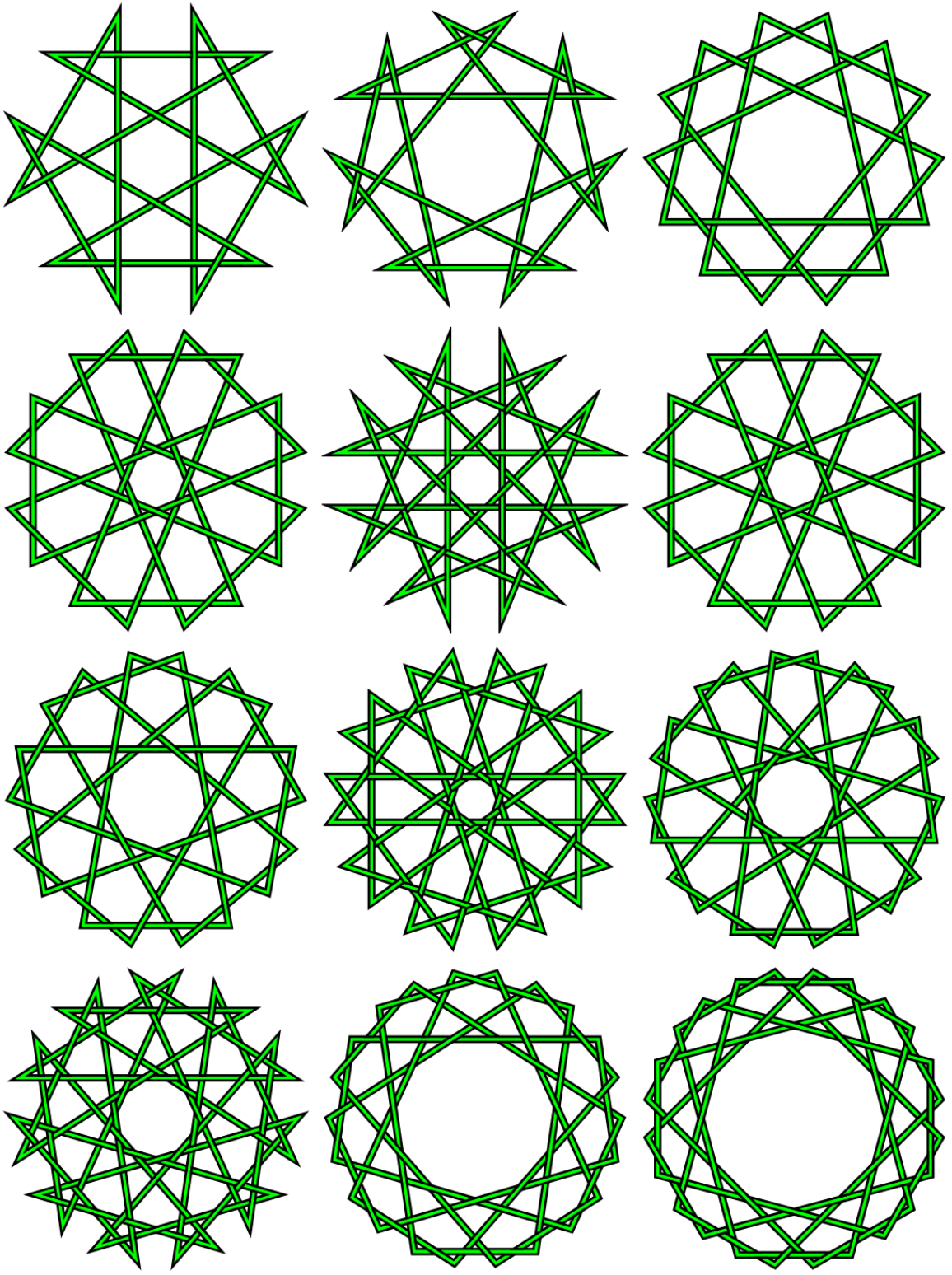 |
This work is licensed under a Creative Commons Attribution 4.0 International License
