Basic Examples (2)
Expand a simple quadratic polynomial:
Expand a simple rational function:
Scope (5)
Complex-conjugate factorization of a real quadratic:
Verify that the expansion correctly represents the original function in the real line:
Branch-corrected expansion near a real root:
On the principal branch, when x>2 the factor 1-x/2 is negative real, each Arg contributes π. ArgAffineExpand automatically inserts a compensating piecewise constant term 2π so the result is exactly equal to the original input on the principal branch. A similar branch correction for a simple rational function:
Expansion for a rational input - zeros minus poles, with sign and branch corrections:
Verify that the result is correct:
Root objects may appear in the result:
Use ToRadicals to express using radicals (may not work always):
Root objects in the expansion of a rational function:
Properties and Relations (3)
PowerExpand applies identities like Arg(ab)=Arg(a)+Arg(b) under generic assumptions and without managing branches, so it may stop at non-affine factors and either omit necessary 2π corrections or emit complex corrections:
ArgAffineExpand always expands into affine factors and simplified 2π corrections:
Similarly for rational expressions:
Possible Issues (2)
For ArgAffineExpand to work, all constants appearing in the expression should be real and numeric. It won't work for symbolic or complex parameters:
ArgAffineExpand gives an expansion which is guaranteed to be correct for real x only. It may not be valid for complex x:
Neat Examples (5)
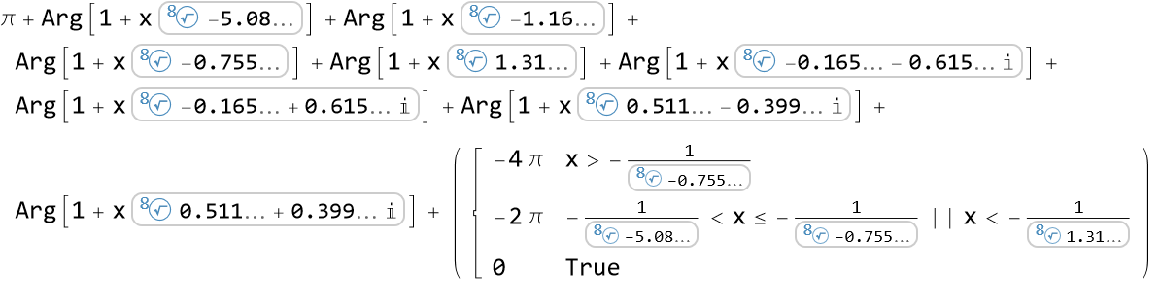
Expansion of a high degree polynomial:
Build a polynomial as six factors:
ArgAffineExpand reduces its Arg to a constant plus one affine Arg per factor, inserting a piecewise 2π term for principal-branch correctness:
For a polynomial with repeated roots, the multiplicities reflect in the coefficients of the affine-Arg factors:
For real quadratics with negative discriminant, the two affine-Arg terms are complex conjugates. Their imaginary parts cancel for real x, so the result is purely real with no branch correction needed:
On rationals like (x^2-1)/(x-1)=1+x, the expansion cancels the common factor and reduces to Arg[1+x] (up to the usual constant/branch bookkeeping):
![ResourceFunction["ArgAffineExpand"][Arg[1 - x^2], x]](https://www.wolframcloud.com/obj/resourcesystem/images/960/960b6a74-dc0d-43e5-b52d-54f14c981bec/655cf908b5aab34d.png)

![ResourceFunction["ArgAffineExpand"][Arg[(1 - x)/(1 + x)], x]](https://www.wolframcloud.com/obj/resourcesystem/images/960/960b6a74-dc0d-43e5-b52d-54f14c981bec/6b0cf60f1eeefbf0.png)

![res = ResourceFunction["ArgAffineExpand"][Arg[x^2 + x + 1], x]](https://www.wolframcloud.com/obj/resourcesystem/images/960/960b6a74-dc0d-43e5-b52d-54f14c981bec/553936acd1a4cd16.png)

![Table[Chop[N@Arg[x^2 + x + 1] - res], {x, -100, 100, 10}]](https://www.wolframcloud.com/obj/resourcesystem/images/960/960b6a74-dc0d-43e5-b52d-54f14c981bec/0fd4b8c17123415c.png)

![ResourceFunction["ArgAffineExpand"][Arg[(x - 2)^2], x]](https://www.wolframcloud.com/obj/resourcesystem/images/960/960b6a74-dc0d-43e5-b52d-54f14c981bec/52a6ddec91d8b755.png)

![ResourceFunction["ArgAffineExpand"][Arg[1/x], x]](https://www.wolframcloud.com/obj/resourcesystem/images/960/960b6a74-dc0d-43e5-b52d-54f14c981bec/40cc03072f86bea1.png)

![res = ResourceFunction["ArgAffineExpand"][Arg[(x^2 - 1)/(x^2)], x]](https://www.wolframcloud.com/obj/resourcesystem/images/960/960b6a74-dc0d-43e5-b52d-54f14c981bec/131db85d3ee9e0c7.png)

![Plot[Chop[Arg[(x^2 - 1)/(x^2)] - res], {x, -100, 100}]](https://www.wolframcloud.com/obj/resourcesystem/images/960/960b6a74-dc0d-43e5-b52d-54f14c981bec/63a689dfe20cc24e.png)
![ResourceFunction["ArgAffineExpand"][Arg[x^3 - 3 x + 10], x]](https://www.wolframcloud.com/obj/resourcesystem/images/960/960b6a74-dc0d-43e5-b52d-54f14c981bec/31ec3a66b1196904.png)

![ResourceFunction["ArgAffineExpand"][Arg[x^3 - 3 x + 10], x] // ToRadicals](https://www.wolframcloud.com/obj/resourcesystem/images/960/960b6a74-dc0d-43e5-b52d-54f14c981bec/0e916e102f4ac707.png)

![ResourceFunction["ArgAffineExpand"][Arg[(x^6 - 3 x + 10)/(x - 2)], x]](https://www.wolframcloud.com/obj/resourcesystem/images/960/960b6a74-dc0d-43e5-b52d-54f14c981bec/64f595a1db9b6ddb.png)

![PowerExpand[Arg[x (x^2 - 1)]]](https://www.wolframcloud.com/obj/resourcesystem/images/960/960b6a74-dc0d-43e5-b52d-54f14c981bec/3ac91398d8a34c08.png)

![PowerExpand[Arg[x (x^2 - 1)], Assumptions -> x \[Element] Reals]](https://www.wolframcloud.com/obj/resourcesystem/images/960/960b6a74-dc0d-43e5-b52d-54f14c981bec/5833ec73264efca1.png)

![ResourceFunction["ArgAffineExpand"][Arg[x (x^2 - 1)], x]](https://www.wolframcloud.com/obj/resourcesystem/images/960/960b6a74-dc0d-43e5-b52d-54f14c981bec/07c76158d7d2d6c0.png)

![PowerExpand[Arg[(x^2 - 1)/(x^4 + x^3 - 10)]]](https://www.wolframcloud.com/obj/resourcesystem/images/960/960b6a74-dc0d-43e5-b52d-54f14c981bec/44c26568ad144a77.png)

![PowerExpand[Arg[(x^2 - 1)/(x^4 + x^3 - 10)], Assumptions -> x \[Element] Reals]](https://www.wolframcloud.com/obj/resourcesystem/images/960/960b6a74-dc0d-43e5-b52d-54f14c981bec/4496dda1ceb98ed0.png)

![ResourceFunction["ArgAffineExpand"][Arg[(x^2 - 1)/(x^4 + x^3 - 10)],
x]](https://www.wolframcloud.com/obj/resourcesystem/images/960/960b6a74-dc0d-43e5-b52d-54f14c981bec/3b45dca5937ffd2f.png)

![ResourceFunction["ArgAffineExpand"][Arg[(k x^2 - 1)], x]](https://www.wolframcloud.com/obj/resourcesystem/images/960/960b6a74-dc0d-43e5-b52d-54f14c981bec/79e3a51a4083ecc0.png)

![ResourceFunction["ArgAffineExpand"][Arg[(I x^2 - 1)], x]](https://www.wolframcloud.com/obj/resourcesystem/images/960/960b6a74-dc0d-43e5-b52d-54f14c981bec/5ff1b8ccfb0b709d.png)

![Arg[1 + 2 x + 2 x^2] /. x -> -1 + I // N](https://www.wolframcloud.com/obj/resourcesystem/images/960/960b6a74-dc0d-43e5-b52d-54f14c981bec/32c74ffc49b0cd57.png)

![ResourceFunction["ArgAffineExpand"][Arg[1 + 2 x + 2 x^2], x] /. x -> -1 + I // N](https://www.wolframcloud.com/obj/resourcesystem/images/960/960b6a74-dc0d-43e5-b52d-54f14c981bec/7a525935998517e9.png)

![ResourceFunction["ArgAffineExpand"][Arg[x^8 - 8 x^3 + 2 x^2 + 5 x - 1],
x]](https://www.wolframcloud.com/obj/resourcesystem/images/960/960b6a74-dc0d-43e5-b52d-54f14c981bec/217c0b705b276baf.png)
![poly = 10*Times @@ Table[1 - x/k, {k, 1, 6}]](https://www.wolframcloud.com/obj/resourcesystem/images/960/960b6a74-dc0d-43e5-b52d-54f14c981bec/09341718dc714cf3.png)

![ResourceFunction["ArgAffineExpand"][Arg[poly], x]](https://www.wolframcloud.com/obj/resourcesystem/images/960/960b6a74-dc0d-43e5-b52d-54f14c981bec/2bf1227759fcbd3d.png)

![ResourceFunction["ArgAffineExpand"][Arg[(x - 2)^5 (x + 5)^8], x]](https://www.wolframcloud.com/obj/resourcesystem/images/960/960b6a74-dc0d-43e5-b52d-54f14c981bec/0267c8feca5780da.png)

![ResourceFunction["ArgAffineExpand"][Arg[x^2 + 2 x + 2], x]](https://www.wolframcloud.com/obj/resourcesystem/images/960/960b6a74-dc0d-43e5-b52d-54f14c981bec/209203b314e7757a.png)

![ResourceFunction["ArgAffineExpand"][Arg[(x^2 - 1)/(x - 1)], x]](https://www.wolframcloud.com/obj/resourcesystem/images/960/960b6a74-dc0d-43e5-b52d-54f14c981bec/37c30e4d886825fa.png)
