Wolfram Function Repository
Instant-use add-on functions for the Wolfram Language
Function Repository Resource:
Compute the homology groups of simplicial complexes
ResourceFunction["SimplicialHomologyGroup"][sc,n] computes the nth homology group of sc. | |
ResourceFunction["SimplicialHomologyGroup"][sc] computes all homology groups of sc. | |
ResourceFunction["SimplicialHomologyGroup"][sc,sub,n] computes the nth homology group of sc relative to sub. | |
ResourceFunction["SimplicialHomologyGroup"][sc,sub] computes all homology groups of sc relative to sub. |
| {"Simplex", n} | n-dimensional simplex | |
| "Point" | point (0-dimensional simplex) | |
| "Line" | line (1-dimensional simplex) | |
| "Triangle" | triangle (2-dimensional simplex) | |
| "Tetrahedron" | tetrahedron (3-dimensional simplex) | |
| {"Circle", n} | n-dimensional circle | |
| "Circle" | circle (1-dimensional circle) | |
| "Sphere" | sphere (2-dimensional circle) | |
| {"CircleWedge", n} | wedge product of n circles | |
| "Torus" | 1-holed (2-dimensional) torus | |
| {"Torus", n} | n-dimensional torus | |
| "KleinBottle" | Klein bottle | |
| "MobiusStrip" | Mobius strip | |
| "RealProjectivePlane" | real projective plane | |
| {"RealProjectiveSpace", n} | n-dimensional real projective space | |
| "ComplexProjectivePlane" | complex projective plane | |
| "QuaternionicProjectivePlane" | quaternionic projective plane | |
| "DunceHat" | dunce hat given by Hachimori (2016) | |
| "PoincareHomologyThreeSphere" | Poincaré homology 3-sphere | |
| "RudinBall" | non-shellable ball constructed by Rudin | |
| "ZieglerBall" | non-shellable ball constructed by Ziegler |
| "Reduced" | True | whether to calculate reduced homology |
| "Coefficients" | Integers | coefficients over which to calculate homology |
Calculate a homology group of a space:
| In[1]:= | ![ResourceFunction["SimplicialHomologyGroup"]["Circle", 0]](https://www.wolframcloud.com/obj/resourcesystem/images/76d/76d50a9d-cf67-4b6e-9866-00334e8eb32b/08079db66170601e.png) |
| Out[1]= |  |
| In[2]:= | ![ResourceFunction["SimplicialHomologyGroup"]["Circle", 1]](https://www.wolframcloud.com/obj/resourcesystem/images/76d/76d50a9d-cf67-4b6e-9866-00334e8eb32b/41e3889e89cf5f3b.png) |
| Out[2]= |  |
| In[3]:= | ![ResourceFunction["SimplicialHomologyGroup"]["Circle", 2]](https://www.wolframcloud.com/obj/resourcesystem/images/76d/76d50a9d-cf67-4b6e-9866-00334e8eb32b/0fe0b109869f1673.png) |
| Out[3]= |  |
0th Homology group of two disjoint points demonstrating the number of connected components:
| In[4]:= | ![ResourceFunction["SimplicialHomologyGroup"][{{1}, {2}}, 0]](https://www.wolframcloud.com/obj/resourcesystem/images/76d/76d50a9d-cf67-4b6e-9866-00334e8eb32b/3d7cc497d396a6c2.png) |
| Out[4]= |  |
Their reduced homology group:
| In[5]:= | ![ResourceFunction["SimplicialHomologyGroup"][{{1}, {2}}, 0, "Reduced" -> True]](https://www.wolframcloud.com/obj/resourcesystem/images/76d/76d50a9d-cf67-4b6e-9866-00334e8eb32b/140111a94a4f9a34.png) |
| Out[5]= |  |
Calculate homology of a contractible complex:
| In[6]:= | ![ResourceFunction["SimplicialHomologyGroup"]["DunceHat"]](https://www.wolframcloud.com/obj/resourcesystem/images/76d/76d50a9d-cf67-4b6e-9866-00334e8eb32b/632c9688afd34b44.png) |
| Out[6]= |  |
Examples of spaces whose homology have torsion:
| In[7]:= | ![ResourceFunction["SimplicialHomologyGroup"]["RealProjectivePlane"]](https://www.wolframcloud.com/obj/resourcesystem/images/76d/76d50a9d-cf67-4b6e-9866-00334e8eb32b/0abfb147ba6065b0.png) |
| Out[7]= |  |
| In[8]:= | ![ResourceFunction["SimplicialHomologyGroup"]["KleinBottle"]](https://www.wolframcloud.com/obj/resourcesystem/images/76d/76d50a9d-cf67-4b6e-9866-00334e8eb32b/32d57dc1d72a16f5.png) |
| Out[8]= |  |
Calculate all homology groups:
| In[9]:= | ![ResourceFunction["SimplicialHomologyGroup"]["Torus"]](https://www.wolframcloud.com/obj/resourcesystem/images/76d/76d50a9d-cf67-4b6e-9866-00334e8eb32b/7d08d5506c838dc1.png) |
| Out[9]= |  |
Calculate the homology groups of D2 relative to its boundary S1:
| In[10]:= | ![ResourceFunction[
"SimplicialHomologyGroup"][{{1, 2, 3}}, {{1, 2}, {2, 3}, {1, 3}}, 2]](https://www.wolframcloud.com/obj/resourcesystem/images/76d/76d50a9d-cf67-4b6e-9866-00334e8eb32b/59e31eaf54c6b6ed.png) |
| Out[10]= |  |
Compute all groups:
| In[11]:= | ![ResourceFunction[
"SimplicialHomologyGroup"][{{1, 2, 3}}, {{1, 2}, {2, 3}, {1, 3}}]](https://www.wolframcloud.com/obj/resourcesystem/images/76d/76d50a9d-cf67-4b6e-9866-00334e8eb32b/7e225fb453d106f5.png) |
| Out[11]= |  |
Specify a simplicial complex using mesh region:
| In[12]:= | ![reg = MeshRegion[{{0, 0}, {1, 0}, {2, 1/2}, {2, -1/2}}, {Line[{1, 2}],
Line[{2, 3}], Line[{3, 4}], Line[{4, 2}]}]](https://www.wolframcloud.com/obj/resourcesystem/images/76d/76d50a9d-cf67-4b6e-9866-00334e8eb32b/48de6864f6bc66f3.png) |
| Out[12]= | 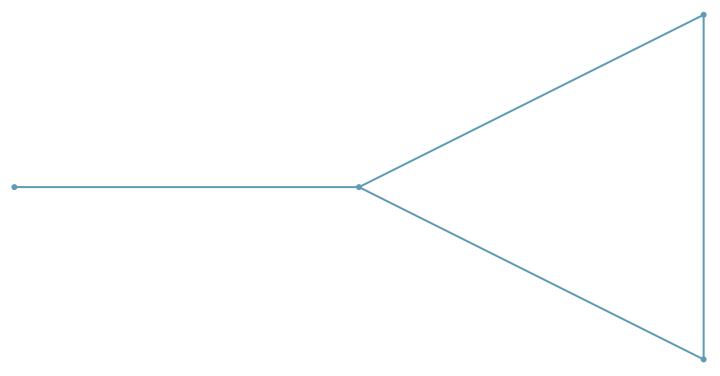 |
| In[13]:= | ![ResourceFunction["SimplicialHomologyGroup"][reg]](https://www.wolframcloud.com/obj/resourcesystem/images/76d/76d50a9d-cf67-4b6e-9866-00334e8eb32b/0590ed51edc2e4ac.png) |
| Out[13]= |  |
By default, ordinary homology is calculated:
| In[14]:= | ![ResourceFunction["SimplicialHomologyGroup"][{"Circle", 2}]](https://www.wolframcloud.com/obj/resourcesystem/images/76d/76d50a9d-cf67-4b6e-9866-00334e8eb32b/5ca352e35f9a73e3.png) |
| Out[14]= |  |
Obtain reduced homology:
| In[15]:= | ![ResourceFunction["SimplicialHomologyGroup"][{"Circle", 2}, "Reduced" -> True]](https://www.wolframcloud.com/obj/resourcesystem/images/76d/76d50a9d-cf67-4b6e-9866-00334e8eb32b/750faaeca5574b1c.png) |
| Out[15]= |  |
By default, homology is computed over the integers:
| In[16]:= | ![ResourceFunction["SimplicialHomologyGroup"]["RealProjectivePlane"]](https://www.wolframcloud.com/obj/resourcesystem/images/76d/76d50a9d-cf67-4b6e-9866-00334e8eb32b/3aeb827fdcd3b971.png) |
| Out[16]= |  |
Calculate over rationals or elements of a finite field:
| In[17]:= | ![ResourceFunction["SimplicialHomologyGroup"]["RealProjectivePlane", "Coefficients" -> Rationals]](https://www.wolframcloud.com/obj/resourcesystem/images/76d/76d50a9d-cf67-4b6e-9866-00334e8eb32b/5449c803ab06b578.png) |
| Out[17]= |  |
| In[18]:= | ![ResourceFunction["SimplicialHomologyGroup"]["RealProjectivePlane", "Coefficients" -> 2]](https://www.wolframcloud.com/obj/resourcesystem/images/76d/76d50a9d-cf67-4b6e-9866-00334e8eb32b/04b121acab5a4161.png) |
| Out[18]= |  |
| In[19]:= | ![ResourceFunction["SimplicialHomologyGroup"]["RealProjectivePlane", "Coefficients" -> 3]](https://www.wolframcloud.com/obj/resourcesystem/images/76d/76d50a9d-cf67-4b6e-9866-00334e8eb32b/66be4144422ece4f.png) |
| Out[19]= |  |
Homology of 8 demonstrating the number of holes in 8:
| In[20]:= | ![eight = DiscretizeGraphics[Text["8"]]](https://www.wolframcloud.com/obj/resourcesystem/images/76d/76d50a9d-cf67-4b6e-9866-00334e8eb32b/0706e09e3ecad1dc.png) |
| Out[20]= |  |
| In[21]:= | ![ResourceFunction["SimplicialHomologyGroup"][eight]](https://www.wolframcloud.com/obj/resourcesystem/images/76d/76d50a9d-cf67-4b6e-9866-00334e8eb32b/1beb4756ce04d877.png) |
| Out[21]= |  |
The homology groups of a space relative to itself are always zero:
| In[22]:= | ![ResourceFunction["SimplicialHomologyGroup"]["Torus", "Torus"]](https://www.wolframcloud.com/obj/resourcesystem/images/76d/76d50a9d-cf67-4b6e-9866-00334e8eb32b/3de9a7ad24c7e426.png) |
| Out[22]= |  |
The homology groups of a space relative to empty space are the same as absolute homology groups:
| In[23]:= | ![ResourceFunction["SimplicialHomologyGroup"]["Torus"]](https://www.wolframcloud.com/obj/resourcesystem/images/76d/76d50a9d-cf67-4b6e-9866-00334e8eb32b/79149cbfeb8b9e59.png) |
| Out[23]= |  |
| In[24]:= | ![ResourceFunction["SimplicialHomologyGroup"]["Torus", {}]](https://www.wolframcloud.com/obj/resourcesystem/images/76d/76d50a9d-cf67-4b6e-9866-00334e8eb32b/3a3f1c6b1066bc4b.png) |
| Out[24]= |  |
Homology groups relative to a point are equal to reduced homology groups:
| In[25]:= | ![ResourceFunction["SimplicialHomologyGroup"]["Sphere", {{1}}]](https://www.wolframcloud.com/obj/resourcesystem/images/76d/76d50a9d-cf67-4b6e-9866-00334e8eb32b/53d282d83e664cce.png) |
| Out[25]= |  |
| In[26]:= | ![ResourceFunction["SimplicialHomologyGroup"]["Sphere", "Reduced" -> True]](https://www.wolframcloud.com/obj/resourcesystem/images/76d/76d50a9d-cf67-4b6e-9866-00334e8eb32b/33ae587e4992be59.png) |
| Out[26]= |  |
A valid subcomplex must be provided:
| In[27]:= | ![ResourceFunction["SimplicialHomologyGroup"][{{1}}, {{2}}]](https://www.wolframcloud.com/obj/resourcesystem/images/76d/76d50a9d-cf67-4b6e-9866-00334e8eb32b/5f69159fa810e110.png) |
| Out[27]= |  |
This work is licensed under a Creative Commons Attribution 4.0 International License
