Wolfram Function Repository
Instant-use add-on functions for the Wolfram Language
Function Repository Resource:
Return the path linking two tree nodes specified by their positions
ResourceFunction["FindPathBetweenTreePositions"][start,end] returns a path on that connects the start and end point given their positions on a tree. |
Find a path between two tree positions:
| In[1]:= | ![ResourceFunction["FindPathBetweenTreePositions"][{2, 1}, {1, 2, 3}]](https://www.wolframcloud.com/obj/resourcesystem/images/215/2158a675-0b61-4615-ab48-35e11d14af82/5c27d8af1aec748f.png) |
| Out[1]= |  |
Create a tree:
| In[2]:= | ![SeedRandom["Tree5"];
myTree = RandomTree[40]](https://www.wolframcloud.com/obj/resourcesystem/images/215/2158a675-0b61-4615-ab48-35e11d14af82/370178447c6c3892.png) |
| Out[3]= | 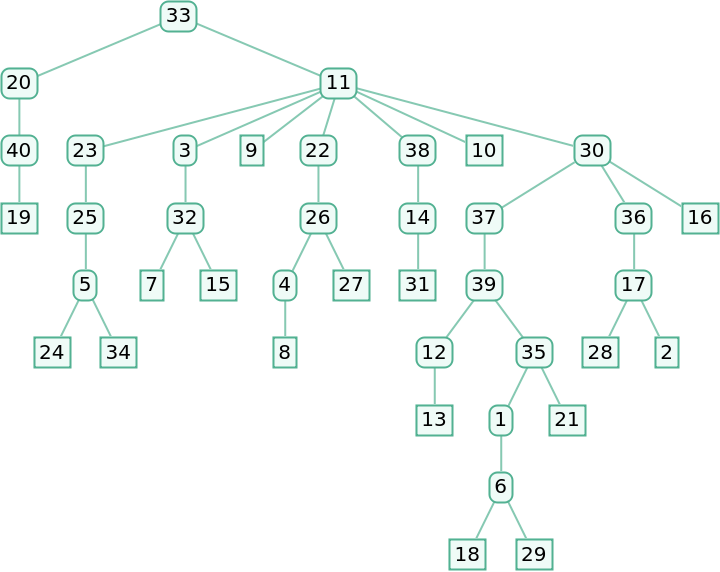 |
Find the path that connects the given nodes labeled 24 and 21:
| In[4]:= | ![{start, end} = First /@ Comap[{TreePosition[24], TreePosition[21]}, myTree]](https://www.wolframcloud.com/obj/resourcesystem/images/215/2158a675-0b61-4615-ab48-35e11d14af82/68db35716605b16a.png) |
| Out[4]= |  |
| In[5]:= | ![ResourceFunction["FindPathBetweenTreePositions"][start, end]](https://www.wolframcloud.com/obj/resourcesystem/images/215/2158a675-0b61-4615-ab48-35e11d14af82/0be291ac077d5275.png) |
| Out[5]= |  |
Visualize the path that connects the given nodes labeled 63 and 82 on the given tree:
| In[6]:= | ![SeedRandom["Tree5"];
myTree = RandomTree[90, ImageSize -> 360];
startAndEnd = First /@ Comap[{TreePosition[63], TreePosition[82]}, myTree]](https://www.wolframcloud.com/obj/resourcesystem/images/215/2158a675-0b61-4615-ab48-35e11d14af82/26c3d07e342b8769.png) |
| Out[8]= |  |
| In[9]:= | ![pth = ResourceFunction[
"FindPathBetweenTreePositions"] @@ (startAndEnd);
Tree[myTree, TreeElementStyle -> (# -> StandardBlue & /@ pth)]](https://www.wolframcloud.com/obj/resourcesystem/images/215/2158a675-0b61-4615-ab48-35e11d14af82/476323ea79592610.png) |
| Out[10]= | 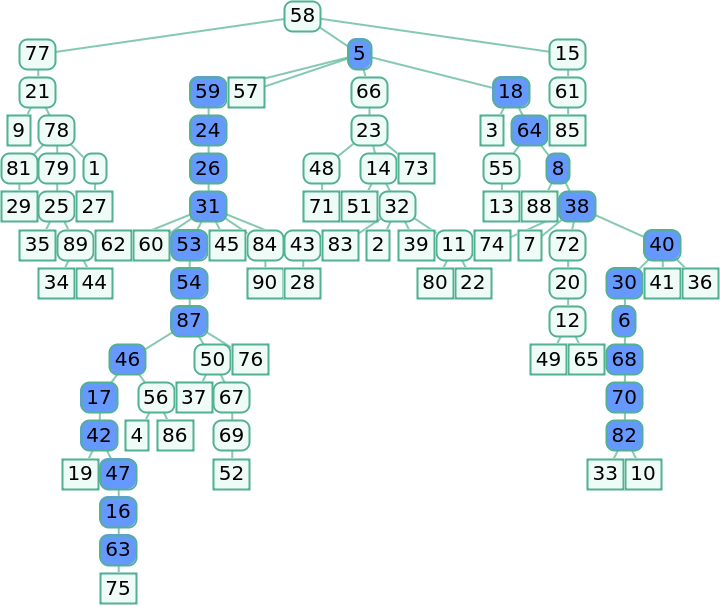 |
If one of the starting point or ending point is {}, then the path always starts or ends at the root node:
| In[11]:= | ![SeedRandom["Tree5"];
myTree = RandomTree[40, ImageSize -> 300];
pth1 = ResourceFunction[
"FindPathBetweenTreePositions"][{}, {2, 7, 1, 1, 2, 2}]](https://www.wolframcloud.com/obj/resourcesystem/images/215/2158a675-0b61-4615-ab48-35e11d14af82/4265b40493e510f5.png) |
| Out[13]= |  |
| In[14]:= | ![Tree[myTree, TreeElementStyle -> MapIndexed[# -> Lighter@ColorData["BlueGreenYellow"][#2[[1]]/7] &, pth1]]](https://www.wolframcloud.com/obj/resourcesystem/images/215/2158a675-0b61-4615-ab48-35e11d14af82/64926f1e9df32efc.png) |
| Out[14]= | 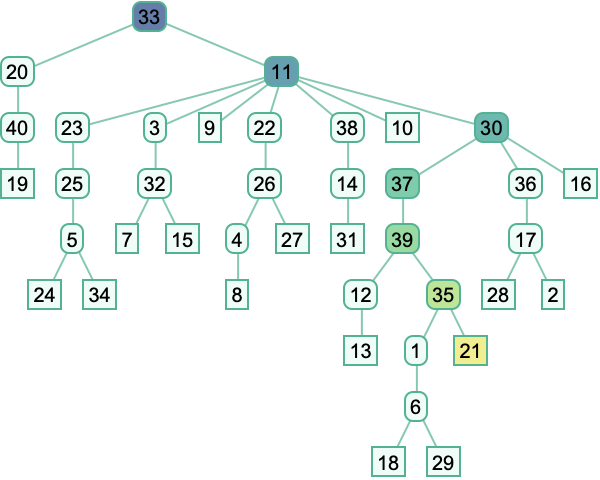 |
| In[15]:= | ![pth2 = ResourceFunction[
"FindPathBetweenTreePositions"][{2, 7, 1, 1, 2, 2}, {}]](https://www.wolframcloud.com/obj/resourcesystem/images/215/2158a675-0b61-4615-ab48-35e11d14af82/4dca3a2712907889.png) |
| Out[15]= |  |
| In[16]:= | ![Tree[myTree, TreeElementStyle -> MapIndexed[# -> Lighter@ColorData["BlueGreenYellow"][#2[[1]]/7] &, pth2]]](https://www.wolframcloud.com/obj/resourcesystem/images/215/2158a675-0b61-4615-ab48-35e11d14af82/6a072ab95d5e29d6.png) |
| Out[16]= | 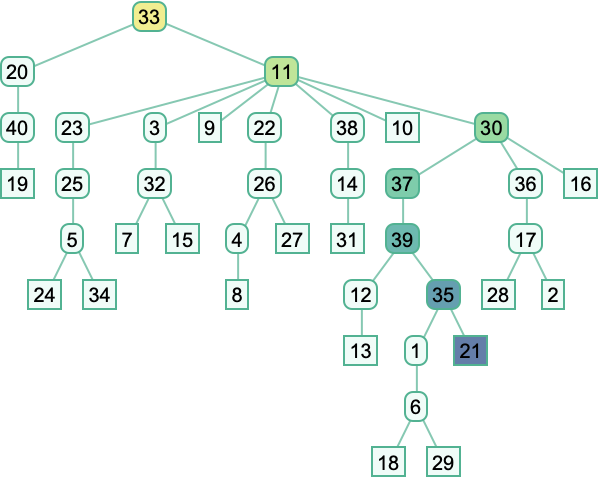 |
If the starting point and ending point are identical, then the path is the list of single element if it is valid:
| In[17]:= | ![SeedRandom["Tree5"];
myTree = RandomTree[40, ImageSize -> 300];
pth = ResourceFunction[
"FindPathBetweenTreePositions"][{2, 7, 1, 1, 2, 2}, {2, 7, 1, 1, 2, 2}]](https://www.wolframcloud.com/obj/resourcesystem/images/215/2158a675-0b61-4615-ab48-35e11d14af82/7f9e3ae84af620ad.png) |
| Out[18]= |  |
| In[19]:= | ![Tree[myTree, TreeElementStyle -> (# -> StandardBlue & /@ pth)]](https://www.wolframcloud.com/obj/resourcesystem/images/215/2158a675-0b61-4615-ab48-35e11d14af82/74f7fbc2bb0b62b0.png) |
| Out[19]= | 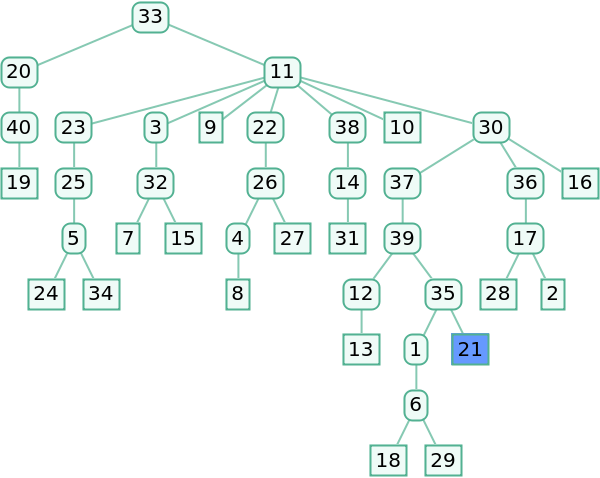 |
If any element of the given positions is not a positive integer, the function returns $Failed:
| In[20]:= | ![ResourceFunction[
"FindPathBetweenTreePositions"][{2, -100, 1, 1, 1}, {2, 7, 1, 1, 2, 2}]](https://www.wolframcloud.com/obj/resourcesystem/images/215/2158a675-0b61-4615-ab48-35e11d14af82/08f3e7e0184174ba.png) |
| Out[20]= |  |
Find all nodes in the tree that are 8 steps away from the node 33 (all values are distinct):
| In[21]:= | ![SeedRandom[12345];
myTree = RandomTree[80, ImageSize -> 360];
Tree[myTree, TreeElementStyle -> {(TreePosition[myTree, 33][[1]]) -> Orange}]](https://www.wolframcloud.com/obj/resourcesystem/images/215/2158a675-0b61-4615-ab48-35e11d14af82/2386ac7b73388a16.png) |
| Out[23]= | 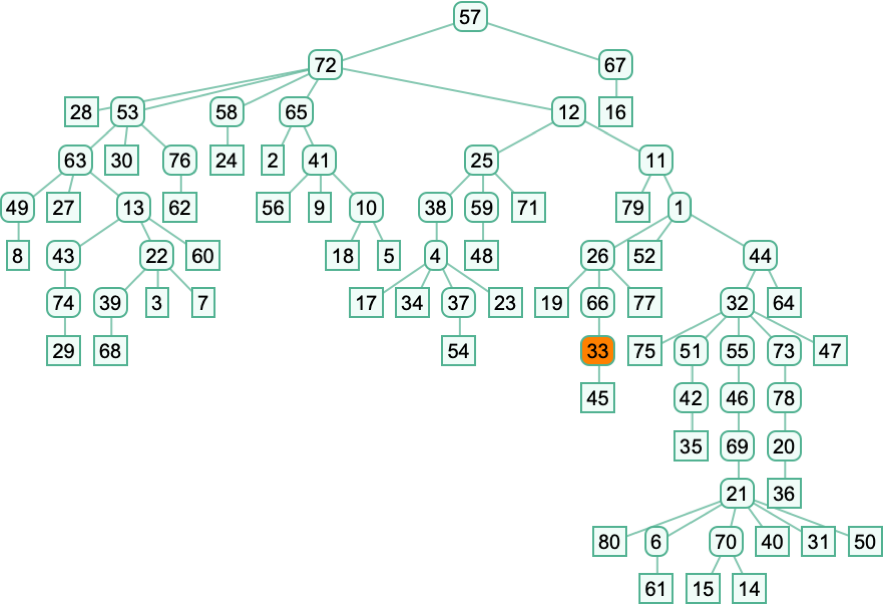 |
Obtain a list of all positions on tree and all paths starting from node with value 33:
| In[24]:= | ![posList = Reap[TreeScan[Sow, myTree, All -> {"Position"}]][[2, 1]];
With[{node = TreePosition[myTree, 33][[1]]},
paths = ResourceFunction["FindPathBetweenTreePositions"][node, #] & /@ Complement[posList, node];
Map[TreeExtract[myTree, #, TreeData] &, paths, {2}] /. {} -> TreeData[myTree]
] // Short](https://www.wolframcloud.com/obj/resourcesystem/images/215/2158a675-0b61-4615-ab48-35e11d14af82/650704be7b601b07.png) |
| Out[25]= |  |
The distribution of the distances between node 33 and other nodes on the tree:
| In[26]:= | ![Histogram[Length /@ paths]](https://www.wolframcloud.com/obj/resourcesystem/images/215/2158a675-0b61-4615-ab48-35e11d14af82/1566dd7b35dcb507.png) |
| Out[26]= | 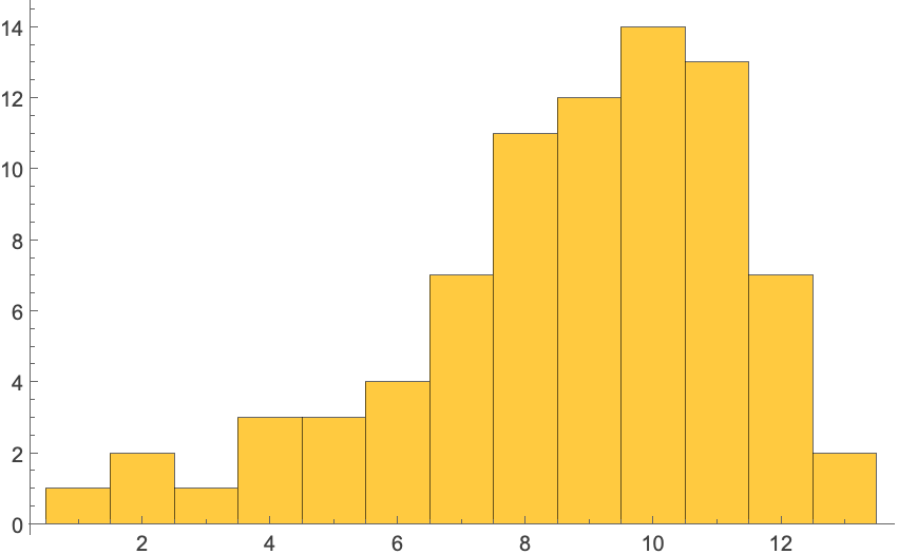 |
| In[27]:= | ![candidates = Select[paths, Length[#] == 8 + 1 &];
Grid[Partition[Table[
Tree[myTree, TreeElementStyle -> (# -> StandardBlue & /@ p), ImageSize -> 360],
{p, candidates}], 4], Dividers -> All]](https://www.wolframcloud.com/obj/resourcesystem/images/215/2158a675-0b61-4615-ab48-35e11d14af82/1d78ae8a2c937592.png) |
| Out[28]= | 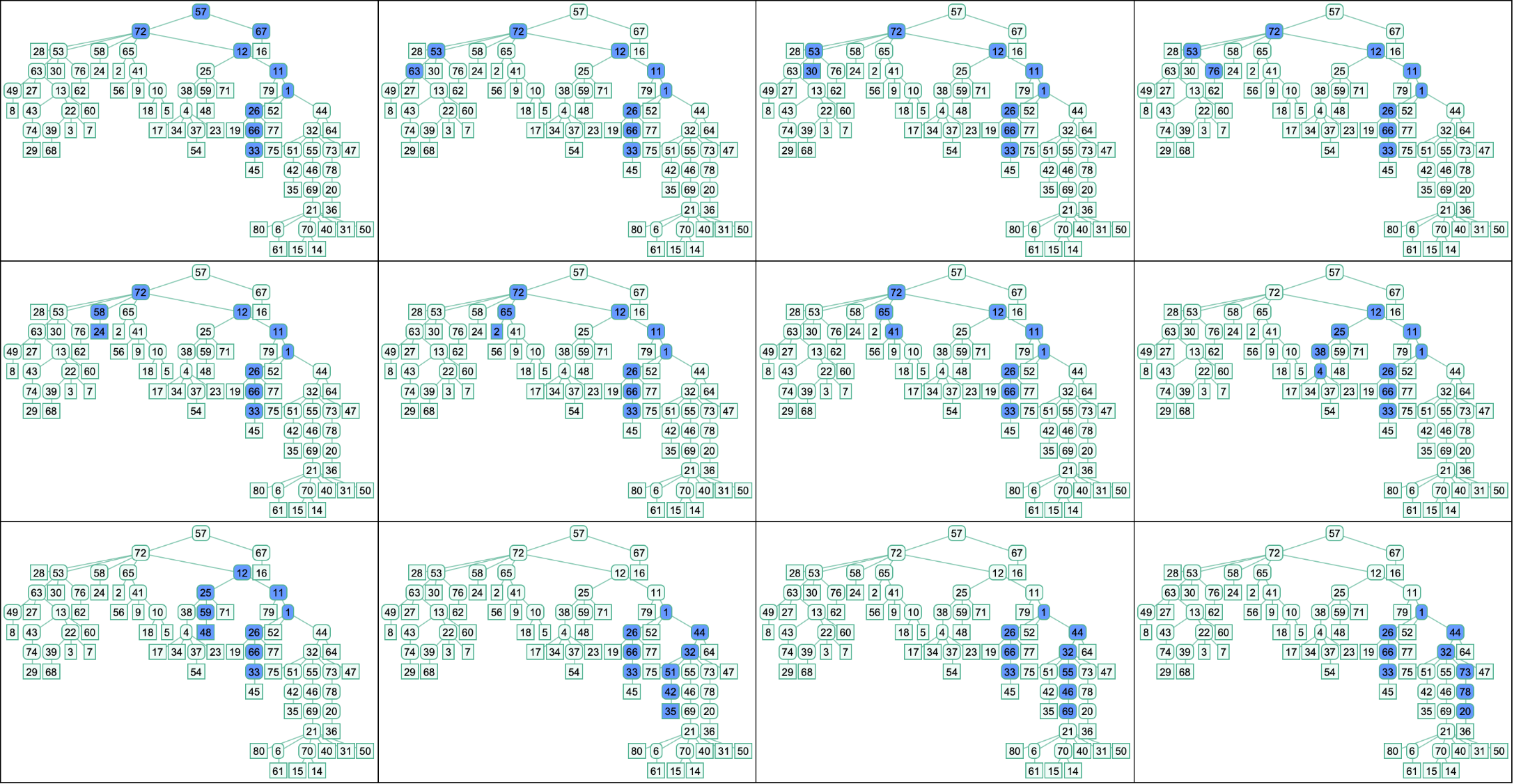 |
A histogram that resembles Half Dome (a mountain in Yosemite):
| In[29]:= | ![SeedRandom["Tree2"];
myTree = RandomTree[199]](https://www.wolframcloud.com/obj/resourcesystem/images/215/2158a675-0b61-4615-ab48-35e11d14af82/33d8195b71687207.png) |
| Out[30]= | 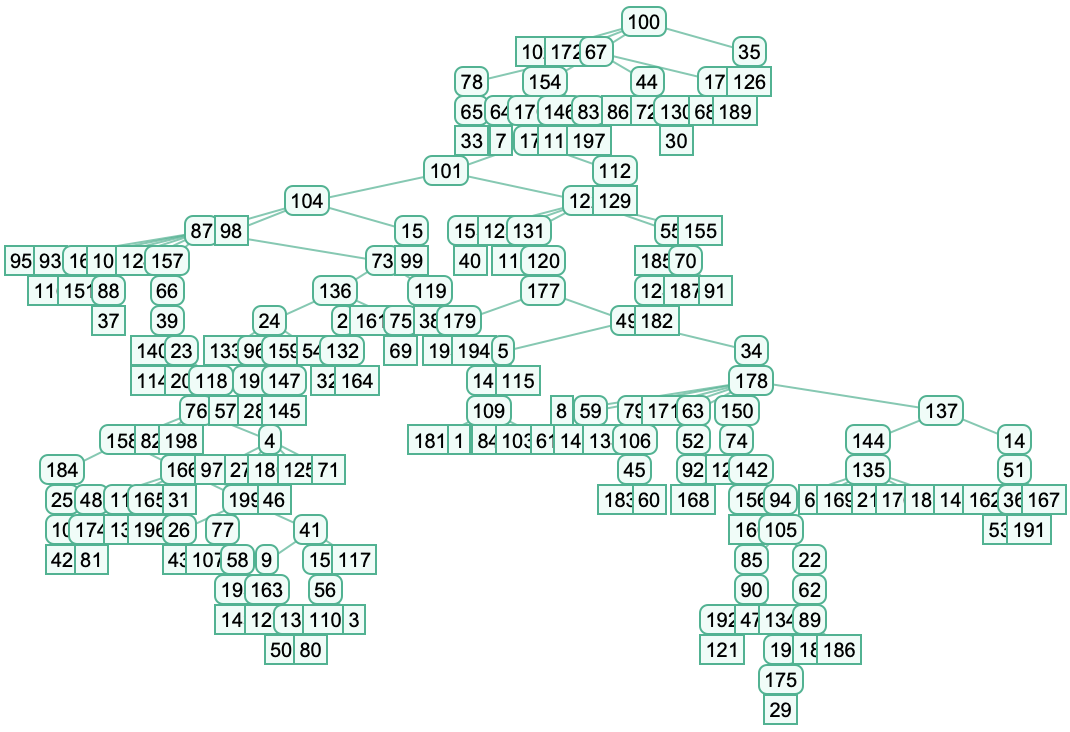 |
Compute pair-wise distance for all nodes and plot their frequency with Histogram:
| In[31]:= | ![Once[LaunchKernels[]];
pos = Reap[TreeScan[Sow, myTree, All -> {"Position"}]][[2, 1]];
pairs = Subsets[pos, {2}];
Histogram[
Length /@ Parallelize[
ResourceFunction["FindPathBetweenTreePositions"] @@@ pairs]]](https://www.wolframcloud.com/obj/resourcesystem/images/215/2158a675-0b61-4615-ab48-35e11d14af82/6f75c7e2629d3724.png) |
| Out[34]= | 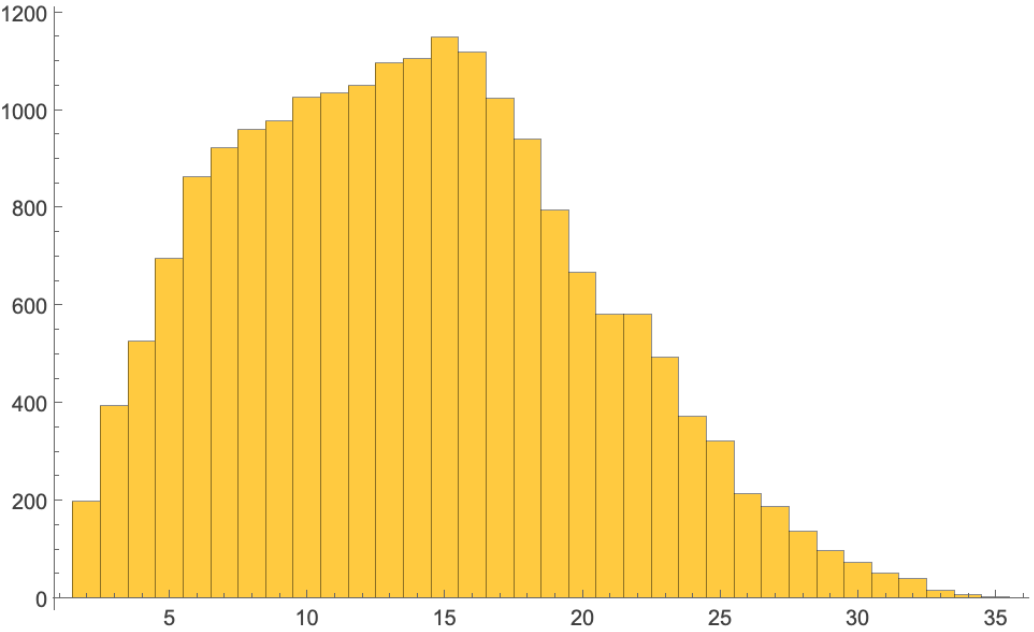 |
Compare with the actual mountain:
| In[35]:= | ![ImageReflect[
First@WebImageSearch["Half Dome Mountain", MaxItems -> 1], Left]](https://www.wolframcloud.com/obj/resourcesystem/images/215/2158a675-0b61-4615-ab48-35e11d14af82/45f37f74cef4bd85.png) |
| Out[35]= | 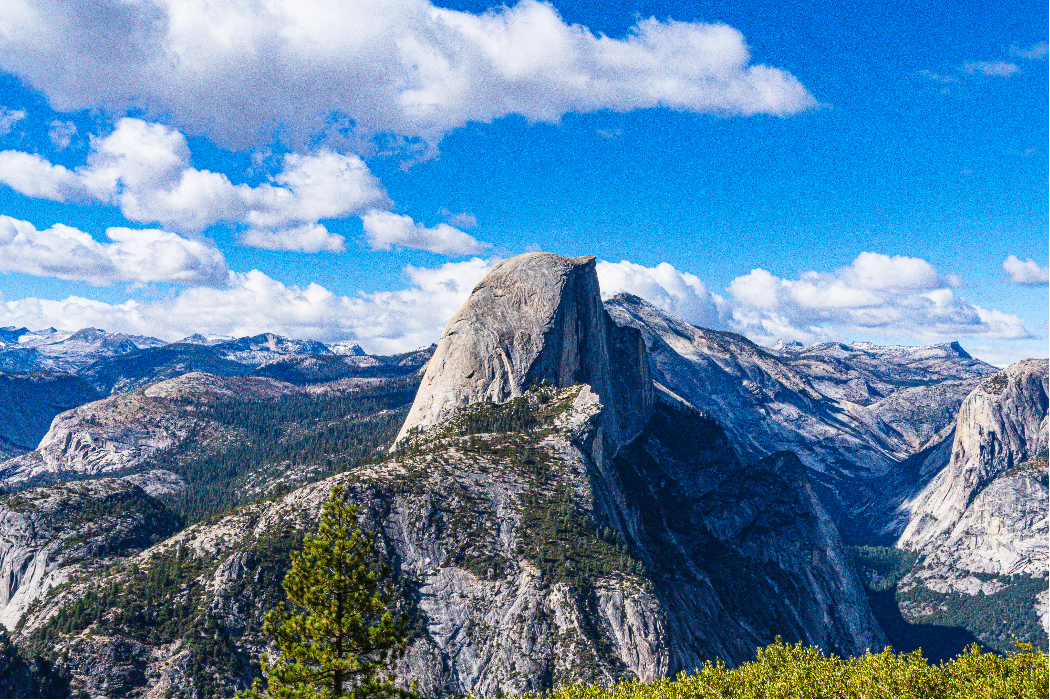 |
This work is licensed under a Creative Commons Attribution 4.0 International License
