Wolfram Language Paclet Repository

Community-contributed installable additions to the Wolfram Language

Primary Navigation

    • Cloud & Deployment
    • Core Language & Structure
    • Data Manipulation & Analysis
    • Engineering Data & Computation
    • External Interfaces & Connections
    • Financial Data & Computation
    • Geographic Data & Computation
    • Geometry
    • Graphs & Networks
    • Higher Mathematical Computation
    • Images
    • Knowledge Representation & Natural Language
    • Machine Learning
    • Notebook Documents & Presentation
    • Scientific and Medical Data & Computation
    • Social, Cultural & Linguistic Data
    • Strings & Text
    • Symbolic & Numeric Computation
    • System Operation & Setup
    • Time-Related Computation
    • User Interface Construction
    • Visualization & Graphics
    • Random Paclet
    • Alphabetical List
  • Using Paclets
    • Get Started
    • Download Definition Notebook
  • Learn More about Wolfram Language

Phi4tools

Guides

  • Phi4tools

Tech Notes

  • Feynman Diagram Evaluation
  • Perturbative Series Generation

Symbols

  • BubbleSubdiagram
  • CountLoops
  • DeriveAndWriteExplicit
  • DrawGraph
  • ExternalMomentum
  • InformationDiagram
  • IntegrandDiagram
  • Momentum
  • MomVars
  • NComponents
  • NickelIndex
  • Propagator
  • SquareSubdiagram
  • SunsetSubdiagram
  • SymmetryFactorDiagram
  • TadSunsetSubdiagram
  • TadTriangleBubblesSubdiagram
  • TriangleSubdiagram
  • ValueDiagram
  • VisualizeDiagram
  • WriteExplicit
  • XCubicRatio
GSberveglieri`Phi4tools`
NComponents
​
​
NComponents
[]
represents the number
Ν
of field components.
​
Details and Options

Examples  
(1)
Basic Examples  
(1)
In[1]:=
Needs["GSberveglieri`Phi4tools`"]
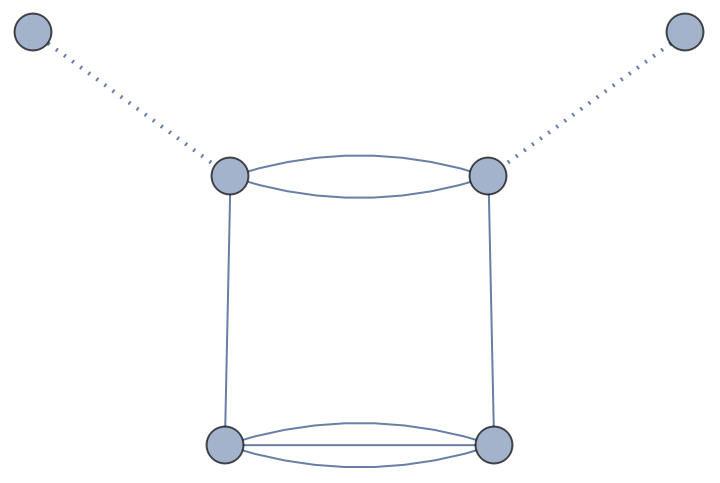
Let's look at the
nd
2
diagram for
(2)
Γ
for the
4
ϕ
theory with
v4
=3 quartic vertices, let's visualize it and print its symmetry factor for the
O(Ν)
model:
In[2]:=

VisualizeDiagram
[2,0,3,1],
SymmetryFactorDiagram
[2,0,3,1]
Out[2]=

,
4
9
+
4Ν
9
+
2
Ν
9

Using the function
InformationDiagram
with the option "Tensor"->"O(N)" is possible to get both these information at the same time, for example
In[3]:=
InformationDiagram
[4,0,3,1,"Tensor""O(N)"]
Out[3]=
External Legs
4
Cubic Vertices
0
Quartic Vertices
3
List Number
1
Nickel Index
ee11|22|ee|
Symmetry Factor

4
9
+
2GSberveglieri`Phi4tools`NComponents[]
9
+
2
GSberveglieri`Phi4tools`NComponents[]
27
,
4
27
,
4
27

Diagram
Value
1
The actual contribution for a given Feynman diagram is given by the product between the value of the diagram and symmetry factor that can be printed with
ValueDiagram
and
SymmetryFactorDiagram
, respectively. For example at the order
4
λ
for
(2)
Γ
In[4]:=
Simplify
ValueDiagram
[2,0,4].
SymmetryFactorDiagram
[2,0,4]
Out[4]=
(10.6771231575200337492±8.×
-19
10
)+Ν((8.72385710756608389503±6.×
-19
10
)+Ν((1.90029513235515074179±9.×
-20
10
)+(0.1038236839760586157907245574±1.2×
-27
10
)Ν))
We could also look at the theory with O(N) model broken to cubic symmetry with the option "Tensor"->"Cubic", for example
In[5]:=
InformationDiagram
[2,0,4,3,"Tensor""Cubic"]
Out[5]=
External Legs
2
Cubic Vertices
0
Quartic Vertices
4
List Number
3
Nickel Index
e112|e3|333||
Symmetry Factor
4
9
+
4Ν
9
+
2
Ν
9
+
8Χ
3
+
4ΝΧ
3
+
16
2
Χ
3
+
2Ν
2
Χ
3
+4
3
Χ
+
4
Χ
Diagram
Value
-0.39527029731357374647297135±1.0×
-25
10
SeeAlso
XCubicRatio
 
▪
SymmetryFactorDiagram
 
▪
ValueDiagram
 
▪
InformationDiagram
TechNotes
▪
Perturbative Series Generation
RelatedGuides
▪
Phi4tools
""

© 2026 Wolfram. All rights reserved.

  • Legal & Privacy Policy
  • Contact Us
  • WolframAlpha.com
  • WolframCloud.com