Wolfram Language Paclet Repository

Community-contributed installable additions to the Wolfram Language

Primary Navigation

    • Cloud & Deployment
    • Core Language & Structure
    • Data Manipulation & Analysis
    • Engineering Data & Computation
    • External Interfaces & Connections
    • Financial Data & Computation
    • Geographic Data & Computation
    • Geometry
    • Graphs & Networks
    • Higher Mathematical Computation
    • Images
    • Knowledge Representation & Natural Language
    • Machine Learning
    • Notebook Documents & Presentation
    • Scientific and Medical Data & Computation
    • Social, Cultural & Linguistic Data
    • Strings & Text
    • Symbolic & Numeric Computation
    • System Operation & Setup
    • Time-Related Computation
    • User Interface Construction
    • Visualization & Graphics
    • Random Paclet
    • Alphabetical List
  • Using Paclets
    • Get Started
    • Download Definition Notebook
  • Learn More about Wolfram Language

TensorNetworks

Guides

  • TensorNetworks

Tech Notes

  • Building Tensor Networks
  • Contraction Paths and Execution
  • Index conventions and contraction path
  • Matrix Product States
  • A Working Tour of the Symmetry Functions
  • Tensor Networks Overview
  • Young Tableaux and Tensor Symmetries

Symbols

  • ActivateTensors
  • BinaryTensorNetwork
  • BinaryTensorNetworkQ
  • CanonicalPath
  • CanonicalPathQ
  • ContractIndices
  • ContractionTree
  • EinsteinSummation
  • GreedyContractionPath
  • HookFactor
  • HookLength
  • HookLengths
  • IndexedMultiply
  • InitializeTensorNetwork
  • MPSCanonicalForm
  • MPSCanonicalQ
  • MPSEntanglementEntropy
  • MPSNormalize
  • MPSNorm
  • MPSOverlap
  • MPSSchmidtValues
  • MPSTruncate
  • OptimalContractionPath
  • PartitionQ
  • PathIndexContractions
  • PathQ
  • PathToTreePath
  • RandomTensorNetwork
  • SchurDimension
  • SparseTensorNetwork
  • TableauColumns
  • TableauDimension
  • TableauRows
  • TableauShape
  • TableauSize
  • TableauWeylDimension
  • TensorNetworkAdd
  • TensorNetworkContraction
  • TensorNetworkContractions
  • TensorNetworkContract
  • TensorNetworkData
  • TensorNetworkDelete
  • TensorNetworkFreeIndices
  • TensorNetworkGraphData
  • TensorNetworkGraphQ
  • TensorNetworkIndexDimensions
  • TensorNetworkIndexGraph
  • TensorNetworkIndices
  • TensorNetwork
  • TensorNetworkQ
  • TensorNetworkRemoveCycles
  • TensorNetworkReplaceIndices
  • TensorNetworkSize
  • TensorNetworkTensors
  • TensorNetworkToNetGraph
  • ToTensorNetworkGraph
  • TransposePartition
  • TreePathQ
  • TreePathToPath
  • YoungProject
  • YoungSymmetrize
  • YoungTableau
  • YoungTableauQ
  • $TensorNetworkContractionMethods
Wolfram`TensorNetworks`Symmetry`
YoungTableau
​
YoungTableau
[rows]
represents a Young tableau, where
rows
is a list of lists of slot indices.
​
​
YoungTableau
[partition]
constructs a standard tableau from an integer
partition
, auto-filling rows in reading order.
​
Details and Options
▪
This symbol lives in the subpackage context
"Wolfram`TensorNetworks`Symmetry`"
. Load it explicitly with
Needs
["Wolfram`TensorNetworks`Symmetry`"]
; loading only the main context does not auto-load this subpackage.
▪
A valid Young tableau has rows of non-increasing length and distinct positive-integer entries. The convenience check
YoungTableauQ
caches its result via the
System`Private`HoldValidQ
pattern, so validation is paid for once per object.
▪
For a standard tableau the entries are a permutation of
1,…,n
where
n
is the total number of boxes; downstream symmetrizers such as
YoungSymmetrize
and
YoungProject
require this convention.
▪
The partition-form constructor numbers cells left-to-right, top-to-bottom:
YoungTableau
[{3,2}]
produces
YoungTableau
[{{1,2,3},{4,5}}]
.
▪
The summary-box icon shows the underlying Young diagram, drawn from the same row data; the displayed properties are the shape (partition), the filling label, and the irrep dimension via the hook-length formula.
▪
The filling label reads "Canonical" when the stored rows are the row-reading standard Young tableau of the shape (the default produced by
YoungTableau
[partition]
), "Standard" when the rows and columns are strictly increasing but the filling is not the canonical one, and "Explicit" otherwise. The label is content-based, so a hand-typed canonical filling such as
YoungTableau
[{{1,2,3},{4,5},{6}}]
also reads "Canonical".
▪
Property accessors include
TableauShape
,
TableauSize
,
TableauRows
,
TableauColumns
,
TableauDimension
,
HookLengths
, and
HookFactor
.
▪
StandardTableauQ
tests whether the filling is a standard Young tableau, that is, whether rows and columns are strictly increasing; the canonical filling always satisfies this.
Examples  
(22)
Basic Examples  
(4)
Construct a Young tableau from explicit rows:
In[1]:=
YoungTableau
[{{1,2,3},{4,5}}]
Out[1]=
YoungTableau
Shape: {3,2}
Filling: canonical
Dimension: 5

​
Construct a standard tableau from an integer partition; the rows are filled in reading order:
In[1]:=
YoungTableau
[{3,2}]
Out[1]=
YoungTableau
Shape: {3,2}
Filling: canonical
Dimension: 5

​
A larger staircase partition:
In[1]:=
YoungTableau
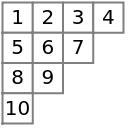
[{4,3,2,1}]
Out[1]=
YoungTableau
Shape: {4,3,2,1}
Filling: canonical
Dimension: 768

​
Read the shape and size of a tableau:
In[1]:=
Withyt=
YoungTableau
[{{1,2,3},{4,5}}],
TableauShape
[yt],
TableauSize
[yt]
Out[1]=
{{3,2},5}
Scope  
(6)

Applications  
(5)

Properties & Relations  
(5)

Possible Issues  
(2)

SeeAlso
YoungTableauQ
 
▪
TableauShape
 
▪
TableauSize
 
▪
TableauRows
 
▪
TableauColumns
 
▪
TableauDimension
 
▪
HookLengths
 
▪
YoungSymmetrize
 
▪
YoungProject
 
▪
PartitionQ
 
▪
Permutations
 
▪
IntegerPartitions
TechNotes
▪
Young Symmetries
RelatedGuides
▪
TensorNetworks
""

© 2026 Wolfram. All rights reserved.

  • Legal & Privacy Policy
  • Contact Us
  • WolframAlpha.com
  • WolframCloud.com