Wolfram Language
Paclet Repository
Community-contributed installable additions to the Wolfram Language
Primary Navigation
Categories
Cloud & Deployment
Core Language & Structure
Data Manipulation & Analysis
Engineering Data & Computation
External Interfaces & Connections
Financial Data & Computation
Geographic Data & Computation
Geometry
Graphs & Networks
Higher Mathematical Computation
Images
Knowledge Representation & Natural Language
Machine Learning
Notebook Documents & Presentation
Scientific and Medical Data & Computation
Social, Cultural & Linguistic Data
Strings & Text
Symbolic & Numeric Computation
System Operation & Setup
Time-Related Computation
User Interface Construction
Visualization & Graphics
Random Paclet
Alphabetical List
Using Paclets
Create a Paclet
Get Started
Download Definition Notebook
Learn More about
Wolfram Language
FinitelyPresentedGroups
Symbols
AlexanderMatrix
CosetTable
ElementEqualQ
ElementReduce
FinitelyPresentedGroup
FoxD
FPGWord
FPGWordReduce
FreeGroup
Taggar`FinitelyPresentedGroups`
F
i
n
i
t
e
l
y
P
r
e
s
e
n
t
e
d
G
r
o
u
p
F
i
n
i
t
e
l
y
P
r
e
s
e
n
t
e
d
G
r
o
u
p
[
g
e
n
e
r
a
t
o
r
s
,
r
e
l
a
t
o
r
s
]
r
e
p
r
e
s
e
n
t
s
a
f
i
n
i
t
e
l
y
p
r
e
s
e
n
t
e
d
g
r
o
u
p
s
p
e
c
i
f
i
e
d
b
y
t
h
e
g
i
v
e
n
g
e
n
e
r
a
t
o
r
s
a
n
d
r
e
l
a
t
o
r
s
.
D
e
t
a
i
l
s
a
n
d
O
p
t
i
o
n
s
▪
The finitely presented group
〈
G
|
R
〉
is the free group
〈
G
〉
quotiented by the relators
R
.
Examples
(
4
)
Basic Examples
(
1
)
Construct a finitely presented group:
I
n
[
1
]
:
=
D
3
=
F
i
n
i
t
e
l
y
P
r
e
s
e
n
t
e
d
G
r
o
u
p
[
{
r
,
s
}
,
{
3
r
,
2
s
,
2
(
s
*
*
r
)
}
]
O
u
t
[
1
]
=
F
i
n
i
t
e
l
y
P
r
e
s
e
n
t
e
d
G
r
o
u
p
[
{
r
,
s
}
,
{
3
r
,
2
s
,
2
(
s
*
*
r
)
}
]
Calculate its order:
I
n
[
2
]
:
=
G
r
o
u
p
O
r
d
e
r
[
D
3
]
O
u
t
[
2
]
=
6
Note that this is
D
i
h
e
d
r
a
l
G
r
o
u
p
[
3
]
and the same can be directly converted into an FPG as follows:
I
n
[
3
]
:
=
F
i
n
i
t
e
l
y
P
r
e
s
e
n
t
e
d
G
r
o
u
p
@
D
i
h
e
d
r
a
l
G
r
o
u
p
[
3
]
O
u
t
[
3
]
=
F
i
n
i
t
e
l
y
P
r
e
s
e
n
t
e
d
G
r
o
u
p
[
{
x
1
,
x
2
}
,
{
3
x
1
,
2
x
2
,
2
(
x
1
*
*
x
2
)
}
]
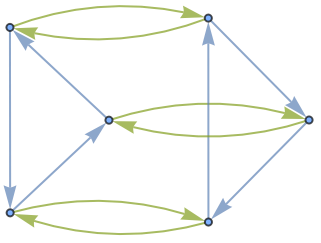
Find its Cayley graph:
I
n
[
4
]
:
=
C
a
y
l
e
y
G
r
a
p
h
F
i
n
i
t
e
l
y
P
r
e
s
e
n
t
e
d
G
r
o
u
p
@
D
i
h
e
d
r
a
l
G
r
o
u
p
[
3
]
O
u
t
[
4
]
=
S
c
o
p
e
(
3
)
"
"