Wolfram Language Paclet Repository

Community-contributed installable additions to the Wolfram Language

Primary Navigation

    • Cloud & Deployment
    • Core Language & Structure
    • Data Manipulation & Analysis
    • Engineering Data & Computation
    • External Interfaces & Connections
    • Financial Data & Computation
    • Geographic Data & Computation
    • Geometry
    • Graphs & Networks
    • Higher Mathematical Computation
    • Images
    • Knowledge Representation & Natural Language
    • Machine Learning
    • Notebook Documents & Presentation
    • Scientific and Medical Data & Computation
    • Social, Cultural & Linguistic Data
    • Strings & Text
    • Symbolic & Numeric Computation
    • System Operation & Setup
    • Time-Related Computation
    • User Interface Construction
    • Visualization & Graphics
    • Random Paclet
    • Alphabetical List
  • Using Paclets
    • Get Started
    • Download Definition Notebook
  • Learn More about Wolfram Language

MMAMixedEffects

Guides

  • MMAMixedEffects

Symbols

  • GeneralizedMixedEffectsModelFit
  • MixedEffectsFamily
  • MixedEffectsModelFit
  • MixedEffectsModel
  • NestedGrouping
  • NonlinearMixedEffectsModelFit
New in:
1.0
| Modified in:
1.2.4
| Obsolete in:
Categorization

Keywords

Syntax Templates

NonlinearMixedEffectsModelFit
NonlinearMixedEffectsModelFit[data,model,starts,{randomParameters,group},vars]

​fits nonlinear parameters with grouped Gaussian variation.​
​
NonlinearMixedEffectsModelFit[data,model,starts,{{random1,group1},{random2,group2},...},vars]

​fits crossed or nested nonlinear random effects.
fits nonlinear Gaussian mixed-effects models from Wolfram expressions.
model is an ordinary Wolfram expression involving covariates and parameter symbols identified by starts.
The model is y_i = f(x_i,beta,b_i) + epsilon_i. Random effects perturb named nonlinear parameters rather than adding directly to the response.
Symbolic first and second derivatives are generated with D. The conditional Hessian includes the residual-times-second-derivative term, not only a Gauss-Newton approximation.
model should be twice differentiable over the fitted parameter region. Nonsmooth constructs such as Abs, Clip, UnitStep, or branch points can make the symbolic Hessian discontinuous and should be replaced by a scientifically appropriate smooth formulation.
The conditional-mode objective is pure: evaluating one outer parameter point does not depend on evaluation order or a cached mode from another point.
Laplace and adaptive Gauss-Hermite integration include Gaussian normalization and residual-whitening determinants.
Multiple random parameter blocks can be crossed, nested, correlated within a block, or independent across blocks.
Weights, offsets, missing-row handling, residual correlations, and variance functions share their Gaussian linear semantics.
Fixed-effect covariance is calculated from curvature of the optimized marginal objective.
Good starting values and sensible parameter scaling remain important for nonlinear models; ConvergenceReport records the numerical evidence.
Known-group prediction adds conditional parameter offsets. MarginalPredictedResponse integrates the nonlinear function over random effects.
Long nonlinear fits report their current stage and objective-evaluation count in a temporary notebook panel unless ProgressReporting is False.
The following options can be given:
Method
"ML"
Use "ML", "Laplace", or "AdaptiveGaussHermite" as convenient method aliases.
LikelihoodApproximation
"Laplace"
Use "Laplace" or "AdaptiveGaussHermite".
QuadratureOrder
7
Gauss-Hermite order per active independent component.
MaxQuadraturePoints
200000
Hard adaptive-quadrature grid limit.
InnerMaxIterations
120
Maximum conditional-mode iterations.
DegreesOfFreedomMethod
"Normal"
Nonlinear fixed effects use marginal-objective normal inference.
ResidualCorrelation
None
Within-block correlation: AR1, ContinuousAR1, CompoundSymmetry, ARMA, Unstructured, Exponential, Gaussian, or Spherical.
ResidualGrouping
Automatic
Expression defining independent residual blocks; Automatic uses the first grouping structure.
ResidualCovariate
Automatic
Time index or coordinate vector used by temporal or spatial residual correlation.
VarianceFunction
"Identity"
Relative residual standard deviations: Identity, ByLevel, Power, Exponential, ConstantPower, or Product.
VarianceCovariate
Automatic
Numeric covariate used by a variance function.
VarianceStrata
Automatic
Levels used by a ByLevel variance function.
Weights
Automatic
Observation weights. Gaussian fitters interpret these as inverse residual-variance weights; generalized fitters report their frequency-weight interpretation.
LinearOffsetFunction
None
A scalar, vector, function, or Wolfram expression added to the linear predictor.
MissingDataMethod
"Exclude"
Use "Exclude" for recorded listwise deletion or "Fail" to reject missing input.
MaxIterations
600
Maximum outer optimizer iterations.
AccuracyGoal
Automatic
Accuracy goal passed to the selected numerical optimizer.
PrecisionGoal
Automatic
Precision goal passed to the selected numerical optimizer.
WorkingPrecision
MachinePrecision
Working precision used by numerical optimization.
OptimizationMethod
Automatic
Use the validated model-specific optimizer strategy, or request a supported explicit optimizer method.
OptimizationStarts
3
Number of deterministic starts; the fit with the smallest valid objective is retained.
ConvergenceTolerance
5
5
10
Nonlinear scaled projected-gradient tolerance; this is forty times tighter than the 0.002 check used by lme4 while avoiding false failure labels at machine precision.
ConfidenceLevel
0.95
Confidence level used for reported fixed-effect intervals.
ProgressReporting
Automatic
Show a live notebook progress panel with the current stage, objective evaluations, best objective, start number, and elapsed time. Automatic is silent without a notebook front end.
EvaluationMonitor
None
An expression evaluated after each uncached marginal-objective evaluation; use RuleDelayed for side effects.
StepMonitor
None
An expression evaluated after each completed outer optimization start; use RuleDelayed for side effects.
The fitted object supports the following property groups:
Data and design
"Data"
Rows used for fitting after missing-data processing.
"Variables"
Ordered predictor and grouping variables.
"IncludedRowIndices"
Original row indices retained for fitting.
"ExcludedRowIndices"
Original row indices excluded from fitting.
"FixedEffectsDesignMatrix"
Fixed-effect design matrix.
"RandomEffectsDesignMatrix"
Sparse random-effect design matrix.
Fixed effects
"FixedEffects"
Association of fixed-effect estimates.
"ParameterTableEntries"
Machine-readable parameter inference entries.
"FixedEffectCovariance"
Estimated covariance matrix of fixed effects.
"FixedEffectCorrelationMatrix"
Corresponding correlation matrix.
Random and residual effects
"RandomEffects"
Conditional modes grouped by random-effect structure.
"RandomEffectCovariances"
Association of estimated covariance matrices.
"ResidualVariance"
Gaussian residual variance, when applicable.
"ResidualParameterEstimates"
Estimated residual correlation and variance-function parameters.
Predictions and residuals
"PopulationPredictedResponse"
Training predictions with random effects set to zero.
"ConditionalPredictedResponse"
Training predictions using conditional random effects.
"MarginalPredictedResponse"
Response-scale predictions integrated over random effects.
"Residuals"
Conditional response residuals.
"PearsonResiduals"
Variance-standardized residuals.
"DevianceResiduals"
Signed deviance residuals when defined.
Likelihood and diagnostics
"LogLikelihood"
Constants-inclusive maximized or approximated log likelihood.
"AIC"
Akaike information criterion.
"BIC"
Bayesian information criterion.
"ConvergenceReport"
Gradient, error, optimizer, mode, and tolerance diagnostics.
"Converged"
True only when documented numerical gates pass.
"SingularFit"
Whether a random-effect covariance lies on a rank boundary.
"Warnings"
Statistical and numerical warnings retained with the fit.
Nonlinear model
"ModelExpression"
Original nonlinear Wolfram expression.
"ParameterSymbols"
Ordered nonlinear parameters.
"ConditionalParameterValues"
Observation-level parameter values after random effects.
See Also
MixedEffectsModelFit
▪
GeneralizedMixedEffectsModelFit
▪
MixedEffectsModel
▪
NestedGrouping
Related Guides
MMA MixedEffects
Related Links
MixedEffectsModel
▪
NestedGrouping
Examples Initialization
Needs["MarcoThiel`MMAMixedEffects`"];root=PacletObject["MarcoThiel/MMAMixedEffects"]["Location"];raw=Rest[Import[FileNameJoin[{root,"Examples","OrangeData.csv"}],"CSV"]];orangeData=({#1〚1〛,#1〚2〛,#1〚3〛}&)/@raw;
Examples
MoreExamples⊳
Fit the Orange logistic growth model with a tree-specific asymptote:
orangeFit=NonlinearMixedEffectsModelFitorangeData,
asym
1+Exp
xmid-age
scal

,{asym200.`,xmid725.`,scal350.`},{{asym},tree},{age,tree}
MixedEffectsModel[GaussianNonlinear, Laplace, 35 observations]
​
Obtain estimates and likelihood diagnostics:
orangeFit[{"FixedEffects","RandomEffectCovariances","ResidualVariance","LogLikelihood"}]
parameter
estimate
asym
192.053
xmid
727.906
scal
348.073
tree variance
1001.49
residual variance
61.5128
log likelihood
-131.572
​
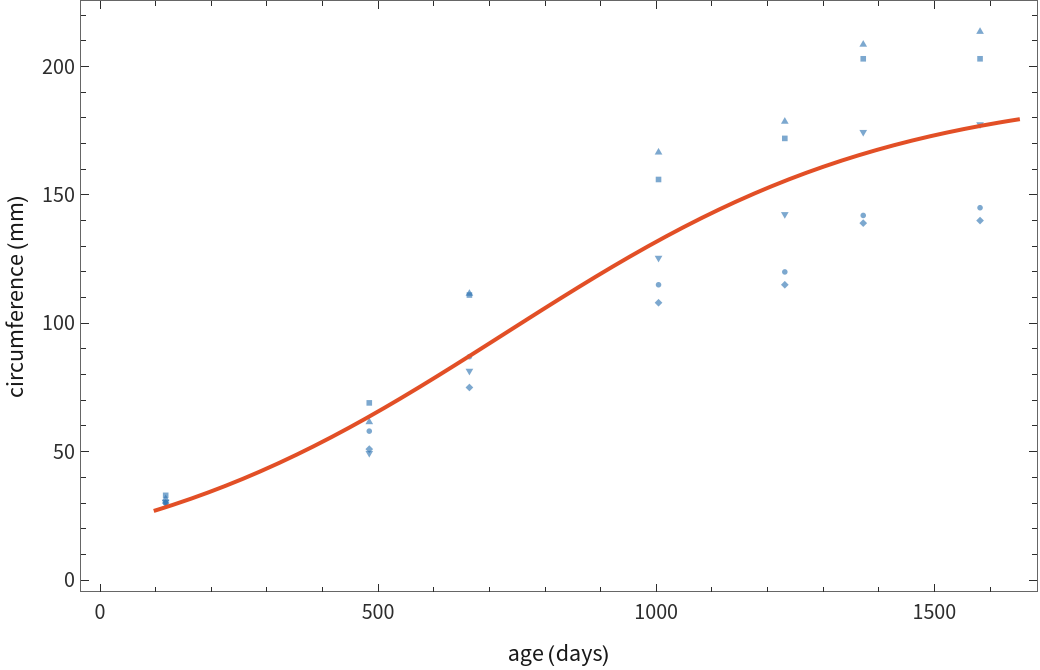
Overlay the fitted population curve on the five observed tree trajectories:
Show[ListPlot[orangeByTree],Plot[orangeFit[Association[agea,tree"new"]],{a,100,1650}]]
More Examples
Fit asymptotic Loblolly growth:
​
Vary two correlated nonlinear parameters:
​
Use nested nonlinear effects:
​
Use AR(1) residual errors:
​
Use a power variance function:
Use adaptive quadrature for a small random-effect dimension:
​
Add a known baseline offset:
Use multiple deterministic starts:
​
Increase conditional-mode work:
Plot population and tree-specific growth curves:
​
Fit the documented CO2 asymptotic-offset uptake curve:
​
Fit two-compartment Indometh pharmacokinetics with correlated amplitudes:
​
Fit the Muscle Michaelis-Menten response despite short uneven groups:
​
Fit the Theophylline oral pharmacokinetic model with two random log-parameters:
​
Exercise a genuine zero-variance boundary with the DNase logistic model:
​
Pool 50 individual ChickWeight growth curves:
Compare population, conditional, and marginal curves:
Diagnose weak parameter identification or a relaxed inner solve:
​
Check a model for nonsmooth symbolic structure before fitting:
​
Keep adaptive quadrature within its explicit tensor budget:
Animate shrinkage of individual growth curves toward the population curve:

© 2026 Wolfram. All rights reserved.

  • Legal & Privacy Policy
  • Contact Us
  • WolframAlpha.com
  • WolframCloud.com