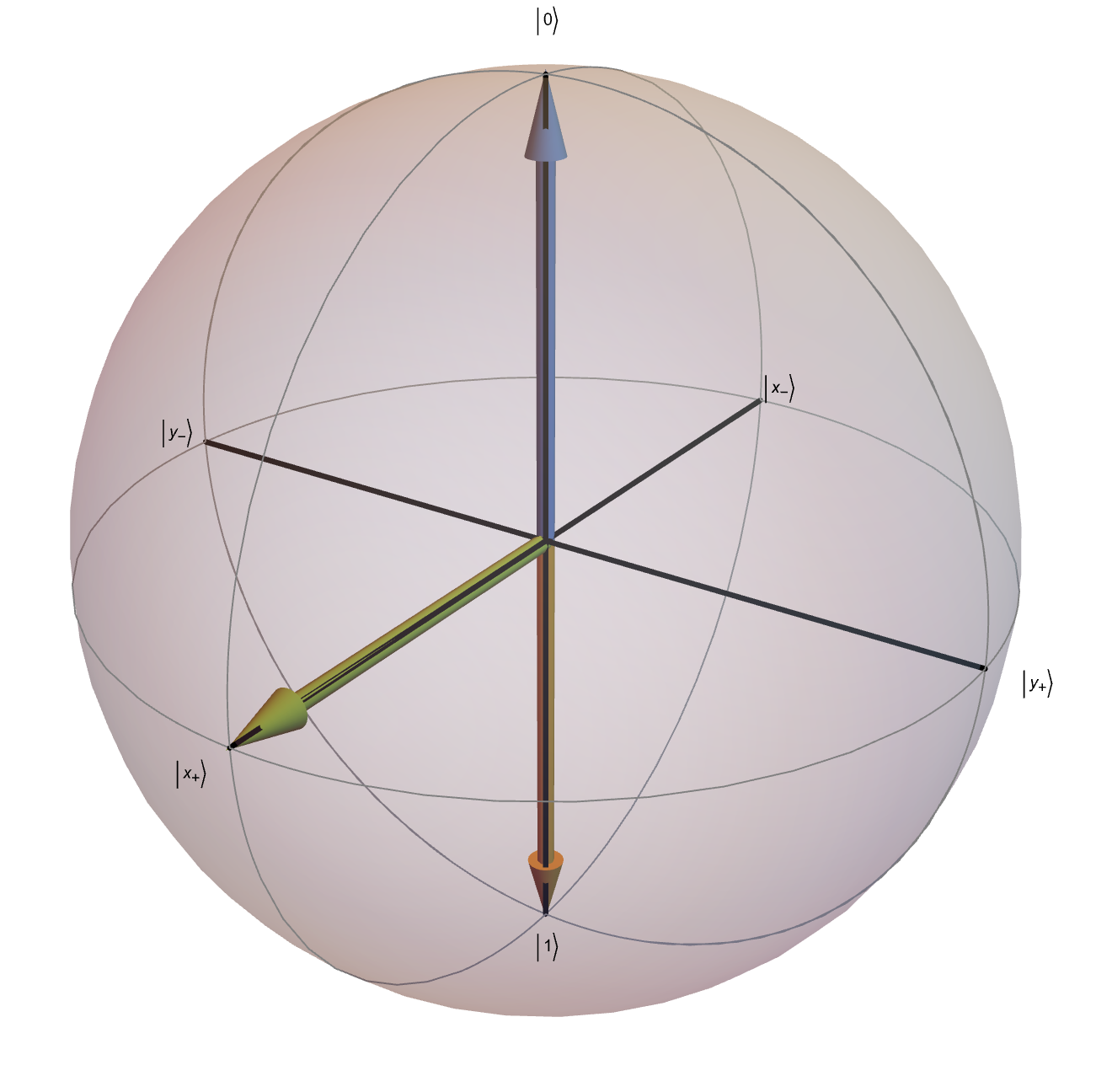
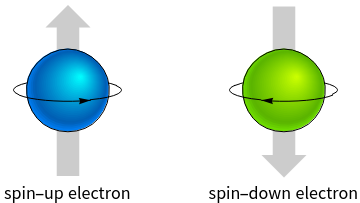
These states are now a linear combination of the two basis states.
Quantum measurements are described by a set of projection operators onto the various basis states of the system.
In the case of a single qubit, one can define the following pair of projection operators:
In[9]:=
(
M
0
={{1,0},{0,0}})//MatrixForm
Out[9]//MatrixForm=
1
0
0
0
In[10]:=
(
M
1
={{0,0},{0,1}})//MatrixForm
Out[10]//MatrixForm=
0
0
0
1
The results of measurement using these operators:
In[11]:=
M
0
.{a,b}//MatrixForm
M
1
.{a,b}//MatrixForm
Out[11]//MatrixForm=
a
0
Out[12]//MatrixForm=
0
b
The probabilities for the measurements are given by
2
a
and
2
b
, respectively, assuming that
2
a
+
2
b
=1
. Note that neither projection operator is invertible because their determinants are zero:
In[13]:=
{Det[
M
0
],Det[
M
1
]}
Out[13]=
{0,0}
Hence we see that application of a projection operator is not reversible.
Consider a pair of qubits, each of which has the basis states
|0〉
and
|1〉
. Suppose that these qubits are allowed to interact for some time. After the interaction, the quantum state of this system of qubits will be a linear superposition of the following basis states:
|00〉,|01〉,|10〉,|11〉
, where the first entry is a label for the first qubit and the second entry is a label for the second qubit.
The following is a linear superposition of the first and fourth states in coordinates:
In[14]:=
(
v
1
={1/Sqrt[2],0,0,1/Sqrt[2]})//MatrixForm(*
v
1
=
1
2
|00〉+
1
2
|11〉*)
Out[14]//MatrixForm=
1
2
0
0
1
2
State
v
1
cannot be "factored" into a tensor product of states because nothing in common is shared. This is an EPR pair, the simplest example of quantum entanglement. Since the first and third entries of the vector represent
|00〉
and
|10〉
, respectively, both with the
|0〉
state for the second qubit, the projection operator for the