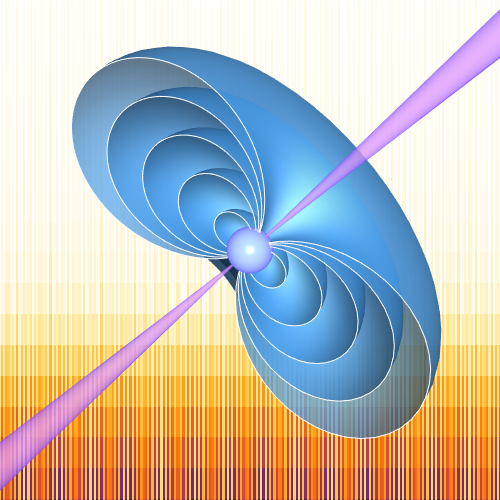
Pulsars are highly magnetized, rapidly rotating stellar remnants whose magnetic axis can be tilted with respect to its rotation axis. Synchrotron radiation is emitted from the magnetic poles, and as the pulsar rotates, it sweeps this beam of radiation through space. If this beam sweeps by the Earth, a periodic pulse of radiation is seen.
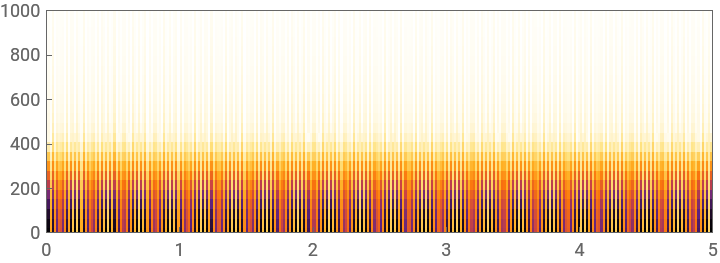
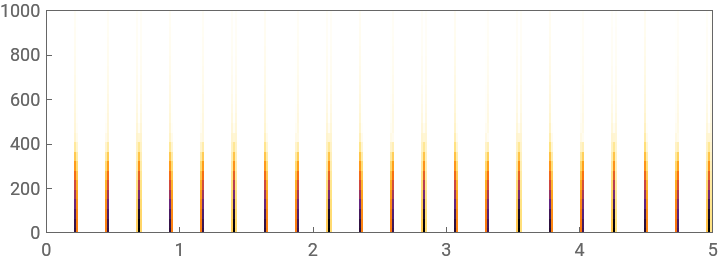
Create a function to simulate the radiation pattern from a given pulsar in time and convert these levels into sound (note: that not all pulsars have a known pulse width, so in that case, a value of 3 ms is assigned). By default, an observation duration of 5 seconds is used:
Visualize a pulsar, showing the radiation beam in purple and the surfaces representing equi-vector magnitudes of the magnetic field strength of an ideal dipole in blue: