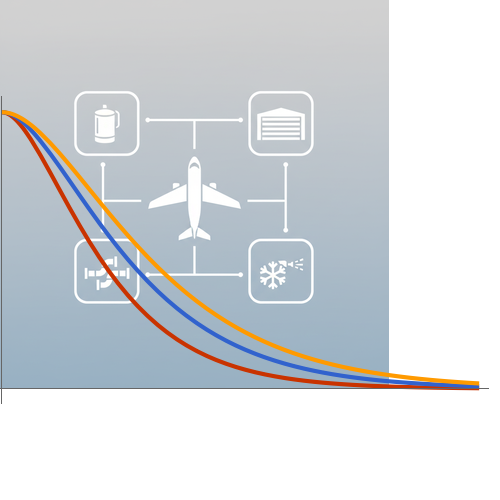
In the following, boolean variables are used to represent the functioning of components of a particular aircraft launch system. The overall ability to launch is formed from a logical combination of the individual component variables.
Model the launch of an aircraft. The hangar door can be opened electronically or manually:
In[1]:=
hangarDoor=power∨manual;
Two fuel pumps (labelled A2 and B2) require power to run:
Two more pumps (A1 and B1) run on reliable batteries. Assuming that fuel transfer requires either pump A1 or A2, as well as either pump B1 or B2, to be functioning gives the following overall fuel transfer structure:
Attach an exponential model to each component with the given failure rates per hour. Note that the electrical power failure rate is left as a free parameter
λ
:
In[6]:=
lifetimes=ExponentialDistribution/@{
-7
10
,
-8
10
,
-3
10
,λ,5×
-4
10
,5×
-4
10
,5×
-4
10
,5×
-4
10
};dists=Transpose[{vars,lifetimes}];
Build the overall system lifetime distribution using the launch success logic:
In[7]:=
ℛ=ReliabilityDistribution[launch,dists];
Compute the survival function (probability the system is still operating at time t) and the mean time to failure:
In[8]:=
sf=SurvivalFunction[ℛ,t]
Out[8]=
1
t<0
-11t/100000000
-t/500
+
-tλ
-
-t/500
+
2
1-
2
(1-
-t/2000
)
True
In[9]:=
μ=Mean[ℛ]
Out[9]=
100000000
200011
+
4
100011
100000000
+λ
-
4
150011
100000000
+λ
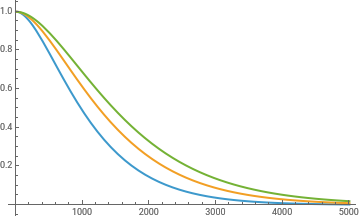
Study how the reliability varies for three different values of the power failure rate