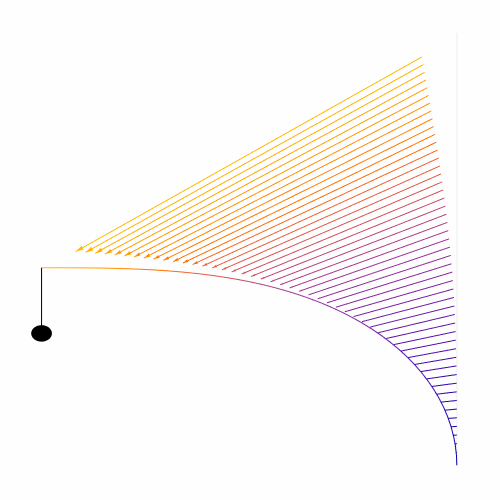
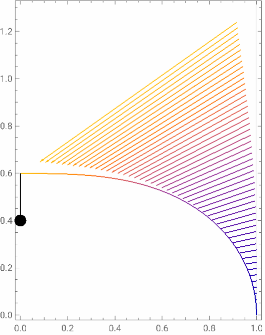
A planar elastica is an idealized, slender elastic rod that bends without stretching and undergoes large geometric deformations. Consider an initially straight vertical rod clamped at its lower end and subjected to a sufficiently large concentrated load at its free end, such that the tangent to the rod becomes horizontal at the loaded end. The goal is to compute the resulting centerline geometry and visualize the deformation of the rod relative to its undeformed configuration.
After integrating the planar Euler-Bernoulli elastica equilibrium equation once and applying the boundary conditions, the arc length can be written in terms of a normalized elliptic integral. The following expression evaluates the arc length measured from a point on the rod to the free end.
Evaluating the arc length at the clamped end gives the total length of the rod in the deformed configuration:
In[2]:=
totalLength=S[0]//N
Out[2]=
1.31103
The vertical coordinate (height) of a point on the deformed elastica is obtained by integrating the vertical component of the tangent vector along the rod:
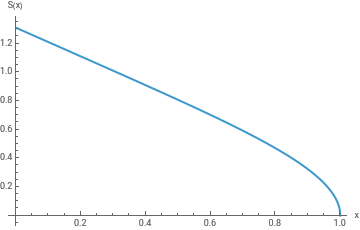
The deformation field uses the inverse mapping from arc length to the auxiliary parameter 𝑥. The following plot verifies that the arc-length function is smooth and monotonic on the interval, ensuring that the inverse mapping used later is well-defined:
Using the arc-length parameter as the independent variable, the displacement field maps points from the undeformed straight configuration to their deformed positions along the elastica. Here we will
The undeformed elastica is represented as a straight vertical line parameterized by arc length and serves as the reference configuration for the displacement field:
In[7]:=
ℛ=ParametricRegion[{1,s},{{s,0,S[0.]}}]
Out[7]=
ParametricRegion[{{1,s},0≤s≤1.31103},{s}]
The deformation of the rod is visualized by applying the displacement field to the undeformed configuration. The applied concentrated load at the free end is indicated schematically:
The displacement field maps each point of the undeformed straight rod, parameterized by arc length, to its deformed position along the elastica. Evaluating this mapping at the total arc length gives the position of the loaded end:
In[9]:=
endPoint=({1,s}+field)/.sS[0.]//N
Out[9]=
{-1.34218×
-16
10
,0.59907}
The difference between the original length and its vertical coordinate measures the vertical shortening due to bending: