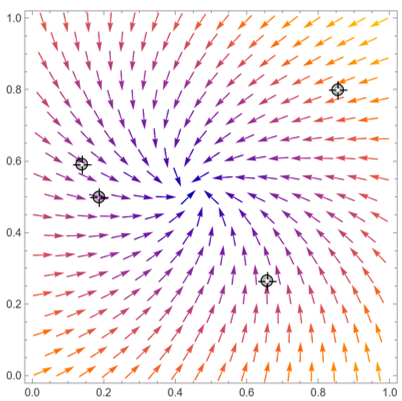
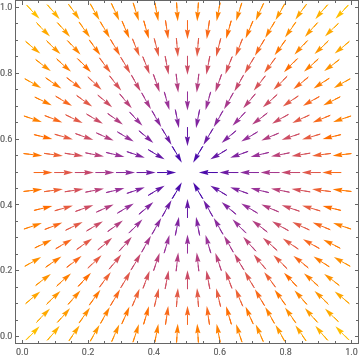
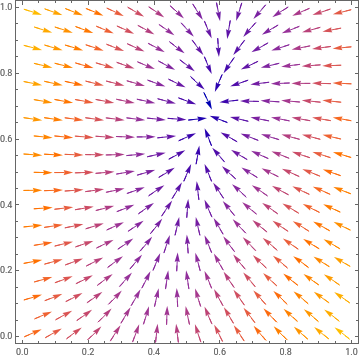
Brouwer's fixed point theorem is an important result in algebraic topology, stating that, in any continuous transformation of a compact, convex set to itself, at least one point remains unaffected. Its applications are very interesting. Suppose you take a sheet of paper, what are the ways in which this sheet can be mapped to itself? We discuss some of those ways in this example.
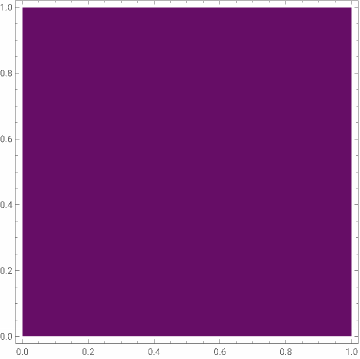
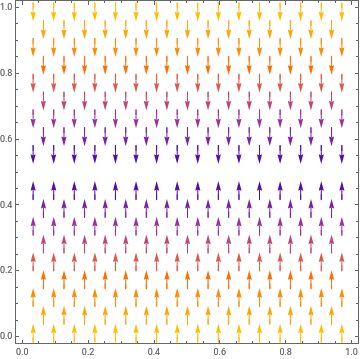
This shows that the displacement of each point is same (equal to 0) as each point is a fixed point. Nothing exciting here. Now, let us consider a map that flips the square over a horizontal axis (that is, (0, 0) ⟷ (0, 1) and (1, 0) ⟷ (1, 1)):
This example illustrated fixed points for affine self-maps of a square through visualization and interactive manipulation. However Brouwer's fixed point theorem goes beyond just affine maps. A very beautiful and classical illustration is that if you stir a glass of water, there is at least one point in the fluid that ends up exactly where it started.